Showing posts with label While My Guitar Gently Weeps. Show all posts

Thursday, 2 April 2020

10:64 Revolution (pt.4) All We Are Saying - Lyrics

Structure

Revolution is one of Lennon's most tightly structured lyrics. You can break the whole song down as follows

Verse: “You say you want to do this, but I'm not sure. I for one have reservations. You say you want to do that but I'm not sure. Again, I have reservations".

pre-chorus: “But when you propose this other thing, that's going too far”.

Chorus: “You should just chill out”.

Employing the Beatles favourite device of parallel lyrics (Ticket 24) makes the structure clearer and more memorable

Verse: “You say you … Well, you know we … You tell me/you ask me … Well, you know we …"

pre-chorus: “But when you/but if you …”

A Mild Case of Rhymes Disease

The facsimiles included in the 50th Anniversary Edition book reveal a Harrison-style list of rhymes

constitution
institution
desolation
revelation
pollution
dissolution
confusion
intrusion
distribution [?]
Constitution [?]

but where While My Guitar Gently Weeps (and Dig A Pony for that matter) succumb to Rhymes Disease, letting rhymes dictate what the song is saying and being so obvious that it distracts from the meaning, Revolution's wordplay manages to be cute and memorable.

In this it shares much with it's spiritual successor, Give Peace A Chance. Released a year later it's another campfire friendly peace anthem, marrying a rhyme-laden, preachy verse to a mantra like chorus. It even gives the previous song a self-referential nod "everybody's talking 'bout revolution, evolution..." If anything Give Peace A Chance distils the core concepts even further and is arguably more successful for it.


Don't Break It Till You Make It


The Beatles weren't afraid to break a rhyme scheme (Ticket 73) if they had a good reason, but here Lennon does something different. The first verse has one rhyme (A) and two repeated lines (b & c), and the first pre-chorus doesn't rhyme at all (X)

Abc Abc XX

A You say you want a revolution
b Well, you know
c We all want to change the world

A You tell me that it's evolution
b Well, you know
c We all want to change the world

X But when you talk about destruction
X Don't you know that you can count me out

But the second and third verses/pre-choruses introduce a more rigorous rhyme structure

AbC AbC DD

2.

A You say you got a real solution
b Well, you know
C We'd all love to see the plan

A You ask me for a contribution
b Well, you know
C We're doing what we can

D But if you want money for people with minds that hate
D All I can tell is brother you have to wait

3.

A You say you'll change the constitution
b Well, you know
C We all want to change your head

A You tell me it's the institution
b Well, you know
C You better free you mind instead

D But if you go carrying pictures of chairman Mao
D You ain't going to make it with anyone anyhow

The rhyme structure works brilliantly as it is (admit it, you didn't even notice, right?) but if the order of the verses are reversed the lack of rhymes in the first part lands badly, especially on the pre-chorus (destruction/count me out). Once you've set up the expectation of rhyme you're committed. So Lennon wisely doesn't let his poetic soul write cheques his rhyming dictionary can't cash. Or something.

This shows how skilful you have to be to use ticket 73. To break a rhyme you really have to be obeying some higher logic or structure device that the listener can sense if only subconsciously.


Ticket 24: Repeat words and sentence structures
Ticket 73: Interrupt the rhyme scheme by rhyming with a previous section or anticipating one that follows

Monday, 8 July 2019

While My Guitar Gently Weeps: Anniversary Edition Notes


While My Guitar Gently Weeps was one of the few post-Rishikesh songs on The Beatles.

Lyrical Development


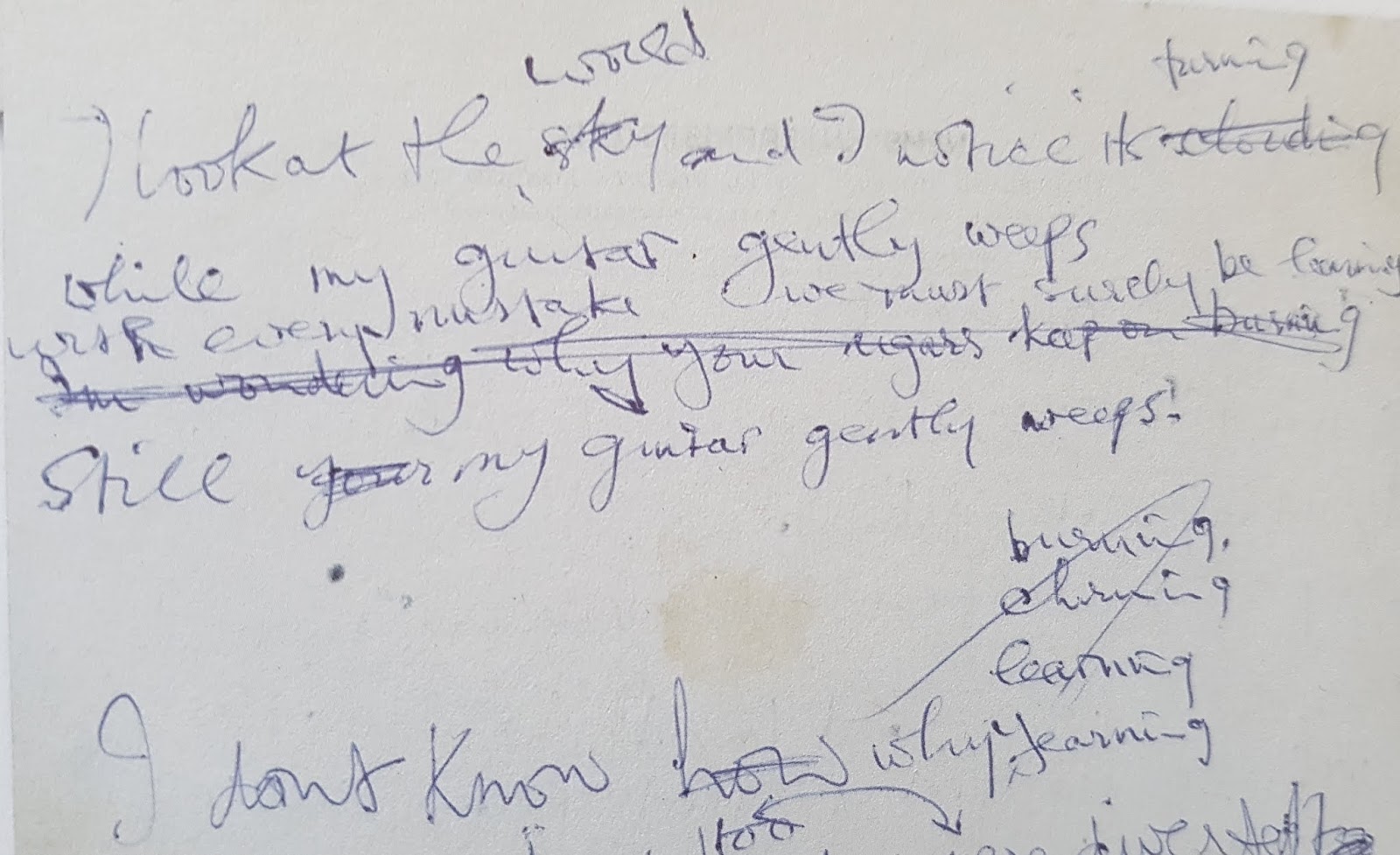
The lyric facsimiles in the anniversary edition, written on 'NEMS London' headed paper, begins with a list of rhymes

Tampering – tapering, Tempering – thundering,
Tittering – Tottering, Towering, Toppling [TICK]
Wandering - Watering, Wavering, Weathering
Whimpering, wintering, whispering, Wondering [TICK]

and later on in the manuscript

Burning
churning
learning
yearning

adding further supporting evidence that Harrison was suffering from a bad case of rhyme's disease when he penned this otherwise excellent song.

The manuscript gives a window into the lyrical development. Verse 1 is fully formed but verse 2 develops from

I look at the sky and I notice it's clouding

which is then replaced by

I look at the world and I notice it's turning
While my guitar gently weeps
I'm wondering why your cigars [?*] keep on burning
still your guitar gently weeps! > still my guitar gently weeps!

After the Burning/churning/learning/yearning list the lyric takes it's final form as

I look at the world and I notice it's turning
While my guitar gently weeps
With every mistake we must surely be learning
Still my guitar gently weeps!

I don't know how, someone controlled you, how they
blindfolded you.

Then the bridge

I don't know how
You were perverted – you were diverted too
I don't know why you got inverted
No one alerted you

undergoes a minor change as 'why' and 'how' change places

I don't know why
You were perverted – you were diverted too
I don't know how you got inverted
No one alerted you

George makes a number of attempts to start verse 3

I look at the powers around

I look at the wars of the world that are raging

I'm thinking of wars everywhere that is raging

I look at the trouble and hate that is raging

none of which he seems as happy with. Verse 3 line 3 is more solid, needing only minor tweaks

While I'm sitting here doing nothing but ageing > As I'm sitting here doing nothing but ageing

This verse survived to the Esher demo

I look at the trouble and pain that is raging
While my guitar gently weeps
As I'm sitting here doing nothing but ageing
Still my guitar gently weeps

by the time they got to Abbey Road (the 'Version 1' acoustic guitar/harmonium 'demo' that appears on Anthology 3 and 'Love') it's become

I look from the wings at the play you are staging
While my guitar gently weeps
As I'm sitting here, doing nothing but ageing
Still my guitar gently weeps

By the final version (Version 3) it's been replaced by a restatement of the first verse

I look at you all see the love there that's sleeping
While my guitar gently weeps
Look at you all
Still my guitar gently weeps

Musical Development

In a similar way the demos and recording notes chart the musical evolution.

Esher demo


  • The key is F#m (Dm capoed at 4th fret)
  • The tempo faster
  • The vocal rhythm is more straight forward and hurried
  • There's a short i to bVII (F#m – E) vamp after the last bridge missing from the finished version
  • At the end of each bridge phrase there's a V to V+ substitution but played inconsistently and not always by both doubled-tracked guitars – revealing it to be an idea that George was perhaps considering but not committed to.

Version 1

The key is Gm. It's still played in Dm but now capoed on the 5th fret. Perhaps the Esher was capoed at 5 too but tuned down a semitone like most of the other demos?

Paul is playing minimal harmonium on the bridge and a few other spots.

The previously undiscovered 'Take 2' outtake has Paul switching to organ but still very much figuring out the chords.

Version 2

According to the studio notes this had John on organ and Paul on bass. Bizarrely the notes state the tape was slowed down by three semitones. From what? If the key had already risen to Gm and was destined to end up in Am it seems strange to start going down again. Three semitones would put the song in Ebm.

Perhaps it's a mistake – three down from the final key Am would put the song back in the Esher key – F#m. Maybe someone is getting their versions mixed up. Until they release a version 2 outtake (anyone out there have one? Send me a link!) we can't be sure.

Version 3

The 'third version take 27' outtake makes it clear the line up is


1 Ringo drums
2 Eric Clapton jamming freely throughout the take on 'Lucy' - the Les Paul he gave to George a month before the session.
3 Paul switching live between piano (intro/verses) and organ (bridges)
4 George on acoustic and George and Paul on vocals

George is attempting Smokey Robinson falsetto/melisma thing that makes him sound like a hypothermic sheep – he halts the take saying “I tried to do a Smokey and I just aren't [sic] Smokey”

Overdubs: George double tracked his vocals and adds more organ (0:58, audible on top of the piano during the guitar solo and continuing for the rest of the song) Ringo adds tambourine and weird sounding tippy-tappy percussion (left speaker 0:34) and there's a distorted bass part played by … who? McCartney on bass (BB) or Lennon on Bass VI (50AE)? It can't be both as the only 'bass' is overdriven and played with a pick.

The case for John

The part, like so many of John's Bass VI performances, is very much a guitar part down an octave, switching between power chords and free flowing single notes riffs rather than diligently performing the role of bass man. Though very un-bass-player-like it's John's best 'bass' performance by a mile.

The case for Paul

From Pepper onwards Paul often overdubbed his bass afterwards. When John played bass, it was usually because they needed it on the basic track and Paul was playing something else (like piano on Long And Winding Road). Here John didn't play on the basic track at all so there was no need for him to play bass – the 'real' bass player could do it. It's likely Paul used his Rickenbacker not the Bass VI (RITH) as the Beatles only had a right-handed one.

If Lennon had provided the Bass VI part it's hard to believe Paul would have been able to resist added a 'real' bass track underneath (as he had done on Back In The USSR). And while it is very 'free' the playing is also tight and disciplined, which is more of a Paul trademark.

The Electric Guitar Mystery – Solved?

Allegedly Lennon is on rhythm guitar (BB) or lead guitar (RITH) but the only electric guitar on the finished track is Clapton switching effortlessly between lead and rhythm.

It used to be thought that Lennon's lead guitar was tracked on the 5th Sep and replaced by Clapton's overdub on the 6th (TBRS). How Clapton's presence was supposed to 'make everyone act better' (as Harrison later stated) when their work on song was already completed is unclear and the outtake answers that - Clapton tracked his part live with the band (on the 5th).

Paul on bass and Eric on guitar leaves John having contributed nothing to the track, but he often absented himself from George's songs so it's a plausible theory.


*According Everett to but it looks more like an 'n' than a 'c' to me!

Sources

50AE: The Beatles 50th Anniversary Edition Book
RITH – Ian McDonald: Revolution In The Head
BB – Beatles Bible
TBRS – Mark Lewisohn: The Beatles Recording Sessions


Join the mailing list to get the free, exclusive, Beatles Songwriting Academy podcast!

Thursday, 18 April 2019

White Album 50th Anniversary Notes (pt.2) - Later Lyrics

More Lyric Facsimiles (Probably Post Rishikesh)


Performance Notes

Several of John's songs have some kind of vocal performance direction above the title.

I'm So Tired - “Smokey then heavy voice” a reference to Smokey Robinson?

Revolution - “Marha [?] - Diana - light voice” perhaps another Motown reference - Martha Reeves and Diana Ross?

Bungalow Bill “Band (Water Melon). children!” possibly a (faintly racist?) reference to the band singing backing vocals?


Lyrical Evolution


I'm So Tired

Verse 2, line 2: my mind is set on you is missing.
Verse 3, line 2: Although I'm so tired > Although I'm choked – Lennon obviously later went back to his first choice.
Verse 3, line 3: I believe Sir Walter Raleigh he was > And curse Sir Walter Raleigh he was

When I wrote about this song I was unsure whether to call the “You'd say I'm putting you on” section a chorus or a bridge but it's labelled “8” so in Lennon's mind it was a middle eight – a bridge.


Don't Pass Me By

Penned in purple felt-tip are (unused) lines that Hunter Davis calls “funny in their awfulness” dubbing Ringo “a modern day William McGonagall”

I feel a little foolish sitting here alone
Instead of eating crackers I think I'll just get stoned

You came all wrapped in cellophane
With purple bursting free
The card said open carefully
And pay for C.OD [sic]


Yer Blues

My Mother was of the earth > My Mother was of the sky
My Father was of the sky > My Father was of the earth
But I am of the underworld > But I am of the universe

I'm feeling so uptight now just Dylan's Mr Jones > I feel so suicidal just Dylan's Mr Jones


Back In The USSR

The final verse is added. The last line is initially missing then added as

Let me hear your balalaika working out > Let me see your balalaika working out

Recorded as Let me hear your balalaika ringing out


While My Guitar Gently Weeps


Written on 'NEMS London' headed paper While My Guitar Gently Weeps begins with a list of rhymes

Tampering – tapering, Tempering – thundering,
Tittering – Tottering, Towering, Toppling [TICK]
Wandering - Watering, Wavering, Weathering
Whimpering, wintering, whispering, Wondering [TICK]

and later on the manuscript

Burning
churning
learning
yearning

adding further supporting evidence that Harrison was suffering from a bad case of rhyme's disease when he penned this otherwise excellent song. The manuscript gives a window into the lyrical development. Verse 1 is fully formed but verse 2 develops from

I look at the sky and I notice it's clouding

which is then replaced by

I look at the world and I notice it's turning
While my guitar gently weeps
I'm wondering why your nigars[?*] keep on burning
still your guitar gently weeps! > still my guitar gently weeps!

[*Everett has it as 'cigars' but it certainly doesn't look like a 'c'!]


After the Burning/churning/learning/yearning list the lyric takes it's final form as

I look at the world and I notice it's turning
While my guitar gently weeps
With every mistake we must surely be learning
Still my guitar gently weeps!

I don't know how, someone controlled you, how they
blindfolded you.

Then the bridge undergoes a minor change

I don't know how
You were perverted – you were diverted too
I don't know why you got inverted
No one alerted you

as 'why' and 'how' change places

I don't know why
You were perverted – you were diverted too
I don't know how you got inverted
No one alerted you

George makes a number of attempts to start verse 3

I look at the powers around

I look at the wars of the world that are raging

I'm thinking of wars everywhere that is raging

I look at the trouble and hate that is raging

none of which he seems as happy with as verse 3 line 3

While I'm sitting here doing nothing but ageing

which is tweaked to

As I'm sitting here doing nothing but ageing

This verse survived to the Esher demo

I look at the trouble and pain that is raging
While my guitar gently weeps
As I'm sitting here doing nothing but ageing
Still my guitar gently weeps

by the time they got to Abbey Road (the 'Version 1' acoustic guitar/harmonium 'demo' that appears on Anthology 3 and 'Love') it's become

I look from the wings at the play you are staging
While my guitar gently weeps
As I'm sitting here, doing nothing but ageing
Still my guitar gently weeps

By the final version it's been replaced by a restatement of the first verse

I look at you all see the love there that's sleeping
While my guitar gently weeps
Look at you all
Still my guitar gently weeps


Birthday

After the section marked “SOLO” [1:28] is one called “STAGGERS” – the guitar/bass solo break [1:48]

Helter Skelter


An embryonic version of the 'jazz-style intro verse' is written after the 'do you don't you' verse supporting my theory that the intro was originally the chorus and the chorus was originally the bridge (or 'middle' as Paul notates it)

I go back to the top of the hill (ride)
And I stop and I turn and I give you a thrill
Till I see you again


Piggies

This is a post Esher version (in pencil) as it containing Lennon's line "Clutching forks and knives to eat their bacon" (Harrison had sung "Clutching forks and knives to cut their pork chops" on the demo). Mrs. Harrison's line "what they need's a damn good whacking!" is overwritten in red pen for emphasis!

There is also a cut 4th verse that George reinstated on the 1992 Live In Japan album.

Everywhere there's lots of piggies
Playing piggy pranks
You can see them on their trotters
At the piggy banks
Paying piggy thanks
To THEE pig Brother


Revolution

contains a Harrison-style list of rhymes

constitution
institution
desolation
revelation
pollution
dissolution
confusion
intrusion
distribution [?]
Constitution [?]


Glass Onion

Written on the back of an envelope, Glass Onion omits the word 'man' from the Walrus and me/close as can be lines and reveals that Lennon was even more ambitious about trying to cram in self-references

Trying to make a dovetail joint for a yellow submarine


The Continuing Story of Bungalow Bill

is titled '(the continuing story of) BUNGALOW BILL'


Hey Jude

She has found you now go and get her > You have found her now go and get her

The final version was only settled on very late in the recording sessions


Next: Recording Notes


Join the mailing list to get the free, exclusive, Beatles Songwriting Academy podcast!

Wednesday, 30 August 2017

10:59 Cry Baby Cry (pt.3) Music


Having looked at the lyrics and the drama behind the song let's finish with the music. Cry Baby Cry has a beautiful natural sounding melody that sits easily on top of some pretty unconventional chords. That's something Lennon excelled at. Here his use of OoKCs (Ticket 28) is not as showy as I Am The Walrus, but just as effective.

Walrus Tears

To start with the chorus melody: Lennon uses the G major blues scale (G A Bb B D E) which means the overall tonality could be viewed as G major or G mixolydian (Ticket 51). The ambiguity comes from the lack of 4ths and 7th – there is no C or C#, F or F# in the melody (Ticket 40). There are lots of F naturals in the harmony which weights the overall tonality towards G mixolydian (G A B C D E F G) but whichever way you land there are out of key notes in both melody and harmony. The harmony favours C natural (in F major, Am and C7) but include C# as well (A7).

The verses makes a switch from G major to the relative minor (Em) and melodically the G major blues scale (G A Bb B D E) becomes the E minor blues scale (E G A Bb B D). Same notes, different starting point (or more accurately a different centre).

This switch to the RELATIVE key is common in songwriting - Crazy Train (Ozzy Osbourne) switches from a 'happy' A major chorus to a 'sad' F#m chorus. Arguably it's not even a real key change since you're only shuffling the notes around, rather than altering them.

But the Beatles much preferred changing between PARALLEL keys (like A major to A minor) which retains the same centre but alters three notes around it. While My Guitar Gently Weeps (1:07-1:28) is a prime example. (Lennon and McCartney's neglect of relative key changes probably explains why it's only now getting it's own ticket. Say hello to Ticket 75!).

Switching between B natural and Bb adds a piquant bluesy flavour (Ticket 22) which can be heard in the C7 chord*, the lead guitar fill (1:17) and the way melody 'sighs' and 'cries' (0:32 and (0:37) from Bb to A to G. This 'madrigalism' (Ticket 49) is also reflected in the “playing piano” line (at 0:20 – 0:28).

The final kicker in the discombobulation stakes is the way Lennon ends his lead vocal on a very unresolved A over an Em chord. Most songs end on the root note and tonic chord which here would mean a G over a G major chord. But Lennon unexpectedly substitutes an Em chord (giving us the legendary Aeolian Cadence - Ticket 10). And A is the 2nd in the key of G major and the 4th in relation to the Em chord. So whichever way you slice it, very unstable and unfinished. And cool.


Contrast

The key change isn't solely responsible for the contrast between verse and chorus. The verse harmony is built on the 'line cliché' of E Eb D Db C B within the chords

Em - Em maj7 - Em7 - Em6 - C7 - G

while the chorus uses simpler chords with much more root movement.

G Am F G Em A7 F G

The verse melody is constructed from a repeated motif with a narrow range (E-B) over moving chords (Ticket 48) whereas the chorus is more expansive and free.


Mama's Little Baby Loves Short'ning

One of the ways Lennon generates tremendous forward momentum throughout the song (apart from omitting any intro, outro or solo) is by cutting out extraneous bars and beats (Ticket 37 – The Lennon Edit). The chorus is four bars long but the first chorus omits the last two beats and the last line of lyrics.

Similarly the verse are truncated. Any other writer would have hung on to G major for a fourth bar just to 'square things up' (0:19). But Lennon's in too much of a rush – so three bars it is. And then he outdoes himself the second time (0:20) cutting the three bar pattern down to two and a half. After all, the verse ends on G major and the chorus starts on G major so why play it twice? Let's edit the edit!

Lennon does it again in the double chorus finale (2:07). The chorus starts and ends G major. So he removes the beginning of the final chorus. Or is it the end of the penultimate one? Who cares! Snip!

By the way, about that verse. Repeating a chord progression is the most normal thing in the world. But the Beatles hardly ever did it. Interesting that...

Arrangement Hall Of Fame

The recording abounds with subtle, yet brilliant, arrangement ideas. Little painterly flourishes like the few seconds of flashy harmonium soloing from George Martin (0:05) never to be heard again, the organ (0:41), Harrison's lead guitar fills in verse three (1:17, 1:26), the piano bassline that brings out the spookiness of the verse progression (1:40). Along with other sonic touches like the gnarly phasing on the acoustic guitar (0:01) and recordings of birds (1:13) all betray crafting. And Ringo is the master craftsman, taking a different approach on every single verse. Check out the great bass/drums groove on verse two (0:39).

So that's Cry Baby Cry completely wrapped up. But there's still one more thing to look at with the track. Can you guess what it is?


*C7 is the bVI7 chord in the key of E minor – a very bluesified choice.


Join the mailing list to get the free, exclusive, Beatles Songwriting Academy podcast!


Friday, 14 October 2016

Under The Influence: Gary Rossington (Lynyrd Skynyrd)


This incredible music [A Day In The Life] just overwhelmed us. When it came to the middle of the song, where the orchestra rises, it sounded like a plane taking off in the room. It just killed us. And when it ended with that incredible chord, we all sat there stunned.

For me [While My Guitar Gently Weeps] was the song of the century. This may sound naïve now, but the Beatles were like gods to me as a kid. Not literally, of course, but it was like they were more than human in some way. This was the point where they embraced heavy blues-based guitar, which made musicians realise you could write modern songs with cool chords that weren't necessarily blues-based and still stick some heavy guitar in them. There were no credits on this album, so I didn't even know it was Clapton for a few weeks, and Eric literally makes his guitar weep at the end. Every guitar player loves this song – because every guitar player has a tear-stained guitar.

Gary Rossington: 'The Hour Of Music That Rocks My World' Guitar World Magazine


Want to receive exclusive bonus Beatles Songwriting Tips? Join the mailing list right here!

Monday, 13 October 2014

10:36 Dear Prudence (pt.1) Ringoing Going Gone

Prudence Farrow with Ringo Starr in Rishikesh. Oh the irony.

Dear Prudence is a fantastic, deceptively simple, song and was one of Lennon's favourites. Perhaps more closely identified with Rishikesh than any other track, it was inspired by Mia Farrow's sister, Prudence, going a little nuts while studying meditation with the Beatles in India. The legend has Lennon singing it outside her door, but Prudence denies hearing the song till she was 'Back In The US(SA)'.

Using the same Donovan/Gypsy Davy finger picking pattern that appears on Julia, Blackbird and Happiness Is A Warm Gun, it's another example of using a technical exercise to write a song (Ticket 59). Other 1968-approved songwriting ideas are the R b7 6 b6 line (Ticket 68) that appeared in While My Guitar (this time in the major form - D, D/C, D/B, D/Bb) and some Lady Madonna style boogie-woogie piano (Ticket 25) making a cameo appearance at 3:31.

Less praiseworthy is the way Lennon (ahem) 'paraphrases' the first line of Raining in My Heart "The sun is out; the sky is blue", changing 'out' to 'up'.

Back in the UK, the band headed for Trident Studios, possibly to take full advantage of the 8 track recorder, laying down tracks that are as inspired as they are scrappy, perfectly capturing the vibe of the song. Ringo however was not there. Having quit the band during the previous session (Back In The USSR) and gone AWOL, Paul stepped up (or rather sat down) in his place.

One of the amazing thing about the Beatles is how world-class songwriters like Lennon, McCartney and Harrison were also prepared to be sidemen on 'the other guy's' songs. And what a sideman Paul McCartney was! – backing vocal, drums, super loud bass, piano, tambourine, cowbell, handclaps and a flügelhorn (audible only to the pure of heart).

I Can't Believe It's Not Ringo™


Let's talk about that drumming. The same kind of 'lead drumming' last heard on A Day In The Life, Paul's performance is so good that many people swear it MUST be Ringo. Conspiracy theorists point to how un-McCartney-like it is compared to his solo era skin-bashing. But let me make this clear. It doesn't matter how much of an expert you think you are. Ringo was in a different country. With his family. Writing Octopus's Garden. And Prudence was completed before his return. Besides, a listen to the semi-isolated track reveals a few flubs amongst the flams. And the fact that the fills are overdubbed onto a basic beat makes McCartney sound slightly better than he really is.

Unusual Prudence

The song is a bit of an oddball for a number of reasons. This is the only example of dropped D tuning I can find in all the Beatles catalogue. It has a fade in/fade out bookended chord progression (Ticket 4) something which only shows up in Eight Days A Week. We have the aforementioned lead drumming and rogue blue notes (in the boogie-woogie piano part) like the cellos in Yesterday and Piggies. And the droning double-D strings in the guitar perhaps reflect the Indian genesis more subtly than Tomorrow Never Knows.

Perhaps most importantly from a songwriting point of view, repeated chord sequences are very un-Beatles-like, though standard procedure today (Demons and Radioactive by Imagine Dragons for examples consist of a single four chord sequence all the way through).

Next time. Stuff about chords, small melodies and which scale we're using.

Monday, 14 July 2014

10:35 While My Guitar Gently Weeps (pt.3 Contrasts, Chords And Words Again)


A Song Of Two Halves

I mentioned last time the lyrics reference both the mundane and the massive. That sense of contrasts is fabulously highlighted by differences between the A (verse) and B (bridge) sections (Ticket 5).

Verse

Key of Am
Repetitive melody, small melodic range
Simple rhymes on '-ing'
Vocal harmonies
Mostly piano (McCartney)

Bridge

Key of A major (Ticket 45)
More meandering melody, larger range (eg the big jump on know WHY and UnFOLD)
Extended rhymes (some might say OVERextended!)
No vocal harmonies
Mostly organ (McCartney and Harrison)


Chords

The chord progression in the verse is brilliant, every chord perfectly sets up the next, the initial Am Am/G D/F# F (giving us R b7 6 b6 in the bass - ticket 68) has a grim inevitability to it but the second time it subtly morphs into Am G D and finishes on E (the V) which leads us strongly back to the beginning. We begin to suspect we're in for a straight repeat, but the second time round Am and G resolve to C (the relative major) - a temporary respite from the gloom. But then the E major sets us up to plunge back in.

Everything hinges (literally) on the E major chord in this song. Not only does it set us up for the Am in the verse but when we get to the bridge it seamlessly prepares the way for the new tonic – A major. And how does the major bridge bring us back to the minor verse? You guessed it – E major.

Lyrics

Many people acknowledge this lyric is a mix of the brilliant and spectacularly bad, though there's debate about where to draw the line. For me the second bridge is a horrific case of rhyme fever - where a desire to rhyme pushes you to say things you didn't necessarily want to say and takes the listener out of the song, by drawing attention to a writer who is trying too hard to be clever. On the other hand the verses work wonderfully for me because they convey the same sense of numb detachment that songs like Because or Blue Jay Way achieve.

Lyrical hooks come from parallel lyrics (ticket 24)

I look at the world/floor/you all
I don't know why/how 

and the direct repetition of

Still my guitar gently weeps

That central concept itself is a totally original phrase, a unique lyrical hook, conceived from a kind of metaphysical poetic exercise (Ticket 59). Harrison, quoted in the Anthology book

I was thinking about the I Ching, the Book of Changes… the Eastern concept is that whatever happens is all meant to be, and that there’s no such thing as coincidence – every little item that’s going down has a purpose.

While My Guitar Gently Weeps was a simple study based on that theory. I decided to write a song based on the first thing I saw upon opening any book – I picked up a book at random, opened it, saw ‘gently weeps’, then laid the book down again and started the song.

Coming soon - Dear Prudence.


Monday, 7 July 2014

10:33 While My Guitar Gently Weeps (pt.1 - Introduction)


Before we take a look at the songwriting let's dig into the back story.

  • George did an acoustic guitar/organ demo on 25 July 1968
  • A full band version was recorded between 16 Aug - 5 Sept, then immediately scrapped. This version has never been released.
  • The final version (featuring Eric Clapton) was cut on 5th - 6th Sept.


Exhibit A in the They Don't Take My Songs Seriously Case, the White Album version of WMGGW was the first thing they recorded after Ringo rejoined the group, having quit 2 weeks before. In that time he'd written Octopus's Garden on a boat in Sardinia while they recorded Back In The USSR and Dear Prudence. (Who made better use of the time? Leave a comment!). So chronologically it belongs after USSR and Prudence, but Ian MacDonald and others mistakenly place it before, because the band started the abandoned version in August. But that's as incorrect as saying One After 909 belongs in the Please Please Me era.

On digital versions the song begins with Lennon shouting 'Aye Up' ('hello' in the Yorkshire dialect) but that almost certainly belongs on the end of The Continuing Story Of Bungalow Bill [Update this has been restored to it's rightful place on the 50th Ann. Edition].

It's a great track that even the uncharacteristically long fade out and sloppy performances can't ruin (there are several instances of wrong chords/bass notes), Ringo's tambourine on the bridge wanders from the 4 to the 2, and lest we overly criticise the others, listen how sloppy Harrison's own double tracked vocals are (1:03, 1:40, 1:56, 3:14).

Great individual parts include Paul's fuzz bass and his “nice intro”* on piano (a deceptively simple hook – Ticket 3), Clapton's guitar (notice how the volume is being altered throughout). Ringo's fast brushes (?) overdub and the arpeggiated guitar (in the left speaker) [UPDATE actually Clapton's track switch between lead and rhythm] are clever details that stop the song becoming leaden.

For me the strongest element in the AABA form (ticket 26) is the A (verse) section. The static melody works well against the ever-moving harmony (ticket 48) and brilliantly supports the lyrical sense of burnt out detachment and hyperrealism – noticing both the mundane (the floor needs sweeping) and the massive (the world turning).

*Harrison quote.

Next time, contrasts, chords and lyrics – good and bad.

Friday, 6 June 2014

Hurry Up George


One really got the impression that George was being given a certain amount of time to do his tracks whereas the others could spend as long as they wanted. One felt under more pressure when doing one of George’s songs.

Geoff Emerick in Mark Lewisohn: The Complete Beatles Recording Sessions

We tried to record [While My Guitar Gently Weeps], but John and Paul were so used to just cranking out their tunes that it was very difficult at times to get serious and record one of mine. It wasn’t happening. They weren’t taking it seriously and I don’t think they were even all playing on it ... [getting Eric Clapton into the studio] made everyone act better. Paul got on the piano and played a nice intro and they all took it more seriously.

George Harrison in Anthology

Almost every Beatles song has a 'story' – the 'story' of While My Guitar Gently Weeps is that Harrison asked Clapton to play on the track to make the rest of the Beatles 'behave' and take the song seriously. The bigger 'narrative' is that Harrissongs were second class citizens at Abbey Road and didn't have the same care lavished on them as Lennon & McCartney tunes.

But is that really true?

The band tracked the song on the 5th Sept 1968. Clapton recorded his part on the 6th. The only contributions on that day, other than George himself, were Paul's vocal harmonies and bass, and Ringo's tambourine and castanets overdubs. It's hard to believe that Eric's presence had any real effect on the band's behaviour at that late stage. UPDATE 50th Anniversary Edition reveals Clapton tracked his part live with the band on the 5th.

What about other tracks?

Here's a list of all George's Beatles tracks* with the number of takes spent on the rhythm track. I've used this as a rule of thumb because that's the only time the whole band would need to be involved. Overdubs might not require any other member.

One Take

Think for Yourself
If I Needed Someone
Blue Jay Way
Savoy Truffle

10 Takes Or Less

All Things Must Pass – 2
Love You To - 3
It's All Too Much - 4
Old Brown Shoe - 4
I Need You - 5
I Want to Tell You - 5
For You Blue – 6
You Like Me Too Much - 8
Only a Northern Song - 9

20 Takes Or Less

Don't Bother Me - 11
Piggies - 11
Here Comes the Sun - 13
Taxman - 15
I Me Mine - 16

40 Takes Or More

While My Guitar Gently Weeps - 43
Something - 49
Long, Long, Long - 67
Not Guilty** – 101


Abbey Road Scrapyard

Four of these tracks were not only laboured over, but recorded, then scrapped, and rerecorded.

Don't Bother Me - 7 takes, then scrapped. Version 2 - 4 more takes.
Taxman - 4 takes, then scrapped. Version 2 - 11 more takes.
While My Guitar Gently Weeps – demoed at Abbey Road 2 takes. Full band version 1 - 14 takes, then scrapped. Version 2 - 28 more takes.
Something -13 takes, then scrapped. Version 2 - 36 more takes.

In the case of While My Guitar Gently Weeps it wasn't merely the backing tracks that were scrapped. After tracking 'version 1' Harrison spent an entire eight-hour session trying to record a backwards guitar solo. The following day he recorded two lead vocal parts, alongside maracas, drums and lead guitar. Then he binned the whole thing, enlisted Eric Clapton and started all over again.

What to make of all this?

The proportion of 1st takes to 101 takes, and of scrapping recordings and starting again, looks broadly same as Lennon & McCartney's work on their own songs. Michelle was recorded (and mixed) in a single day. Happiness Is A Warm Gun took forever. Ob-La-Di, Ob-La-Da and Strawberry Fields Forever were scrapped and rerecorded, as were One After 909 and Hold Me Tight.

As I've written before it's one thing taking up your bandmate's time with something either world class (Strawberry Fields) or very complex (Warm Gun). But imprisoning them in the studio so you can flog a dead horse (Maxwell, Ob-La-Di, Not Guilty) is just going to make everyone crazy.

Looking at the figures it's hard to believe George got a raw deal when he'd made John 'world's shortest attention sp...oh look something shiny' Lennon sit at the Electric Harpsichord for 101 takes***.

George seems to have been indecisive or ill-prepared**** when working on his own songs and, perhaps understandably, lacking in confidence. Compared to the uber-confident, omnicompetent McCartney (who demoed a 'full band' version of Come And Get It on his own, in one hour!) and the laid back Lennon (who often got bored of his own songs before anyone else could) he was perhaps the least fun Beatles to 'work for'.


*I've not included The Inner Light and Within You Without You as no other Beatle was involved with the basic track.

**Not Guilty was not included on The White Album and remained unreleased until Anthology 3.

***Perhaps that explains why Lennon often excused himself when George was recording one of his songs. Of the 22 released, Lennon plays no part in 6, and contributes only backing vocals to 4 others.

****For example each 'version' of While My Guitar has different (or extra) lyrics.

Sunday, 2 December 2012

Remembering Michael Hedges


Today is the anniversary of the death of Michael Hedges, a ground breaking guitarist and incredible composer, all round musician and a Beatles fan. I was going to try to post a few videos, but just about everyone has "embedding disabled by request".

Here's Michael performing

You've Got To Hide Your Love Away with a little help (hinderance?) from the audience
While My Guitar Gently Weeps in a weird hat, just before he died
Come Together from '87 with pigtails, singing McCartney's bassline
Mother's Nature Son with mandolin and violin
Come Together with and without shoes and Pierre Bensusan adding jazzy soloing
a medley of Michael's own tune Gospel and Tomorrow Never Knows from 1985
A Tomorrow Never Knows jam session with Montreux members Darol Anger, Mike Marshall and Todd Philips - Bass
and rocking out on his own composition
Ragamuffin


Friday, 6 July 2012

Beatles Coverville 8


Every thanksgiving Brian Ibbott's show Coverville is given over to a special double length Beatles episode. The latest episode has some great tracks. I loved Girl In A Coma's jangle pop cover of While My Guitar Gently Weeps and Halestorm's brutal take on I Want You (She’s So Heavy) so much that I'm going to feature them in future posts. Also worth a listen is Yer Blues in the capable hands of The Jeff Healey Band.


The Vegetarians cover Magical Mystery Tour and manage to shoehorn in quotes from most of the other MMT songs, Greensky Bluegrass turn Got To Get You Into My Life into a country waltz and Dick Hyman manages to turn an annoying song into... well, you be the judge!

Download the show here

Friday, 21 January 2011

10:34 While My Guitar Gently Weeps In The Lyrical Hall Of Shame


Oh the best laid schemes of mice and men...This week I'd scheduled a post about Lennon's last best song, and a guest post from Nicholas Tozier on Lennon's worst musical moment. But work and songwriting got in the way. So this will have to suffice for now... 

(seriously what schemes does a mouse concoct? 1) Run along the wall 2) find cheese 3) repeat?)


Don't tell me that this is a great song. I know it is. Which makes today's 'lyrical crime against humanity' all the more heinous. The scene of the crime is the second bridge

I don't know how you were diverted
You were perverted too.
I don't know how you were inverted
No one alerted you.


I call this particular crime Rhyme's Disease or "I paid good money for this rhyming dictionary, dammit!".

"Ladies and gentleman of the jury, I put it to you that the defendant was diverted and perverted before finally becoming inverted"
"Your honour, counsel would state in mitigation that at no time had the defendant been sufficiently alerted"
I rest my case.

Related post: She Came In Through The Bathroom Window's Lyric Fail


Friday, 28 May 2010

While My Ukelele Gently Weeps


Lest all the videos of cute japanese kids with ukes has made you think it's not a real instrument - think again! Jake Shimabukuro don't need no stinking six string!


but hey Jake! It looks like someone's been studying your video (or maybe it's the other way ar...? nah! Surely not!!!). Here's Uke3453


Have a great weekend.
And subscribe to this blog - then I'll have a great weekend too!

You might enjoy Coverville, George Harrison & The Templeton Twins


Thursday, 6 May 2010

Coverville, George Harrison & the Legend of the Templeton Twins


There's an interesting podcast called Coverville that feature covers of famous songs by other famous (and not famous) bands. The episode on George Harrison (555) has a nice mix of Beatles and solo stuff (check out Show Of Hands doing If I Needed Someone) but nothing could have prepared me for the psuedo 1920's version of Something by (are you ready for this?) 

The Templeton Twins 
backed by Teddy Turner & his Bunsen Burners

What struck me (apart from the hilarious poker faced arrangement) was how easily the song translated into a jazz crooner vehicle with so little reharmonisation.

 But the plot thickens. The album Trill It Like It Was is long out of print (in fact I'm not sure it's ever appeared on CD) so I did a little research. It turns out The Twins are better known as Van Halen producer Ted Templeman!!!


Here's one other Beatles Templeton/man cover I managed to track down.