Showing posts with label George Harrison (Solo). Show all posts

Thursday, 18 April 2019

White Album 50th Anniversary Notes (pt.2) - Later Lyrics

More Lyric Facsimiles (Probably Post Rishikesh)


Performance Notes

Several of John's songs have some kind of vocal performance direction above the title.

I'm So Tired - “Smokey then heavy voice” a reference to Smokey Robinson?

Revolution - “Marha [?] - Diana - light voice” perhaps another Motown reference - Martha Reeves and Diana Ross?

Bungalow Bill “Band (Water Melon). children!” possibly a (faintly racist?) reference to the band singing backing vocals?


Lyrical Evolution


I'm So Tired

Verse 2, line 2: my mind is set on you is missing.
Verse 3, line 2: Although I'm so tired > Although I'm choked – Lennon obviously later went back to his first choice.
Verse 3, line 3: I believe Sir Walter Raleigh he was > And curse Sir Walter Raleigh he was

When I wrote about this song I was unsure whether to call the “You'd say I'm putting you on” section a chorus or a bridge but it's labelled “8” so in Lennon's mind it was a middle eight – a bridge.


Don't Pass Me By

Penned in purple felt-tip are (unused) lines that Hunter Davis calls “funny in their awfulness” dubbing Ringo “a modern day William McGonagall”

I feel a little foolish sitting here alone
Instead of eating crackers I think I'll just get stoned

You came all wrapped in cellophane
With purple bursting free
The card said open carefully
And pay for C.OD [sic]


Yer Blues

My Mother was of the earth > My Mother was of the sky
My Father was of the sky > My Father was of the earth
But I am of the underworld > But I am of the universe

I'm feeling so uptight now just Dylan's Mr Jones > I feel so suicidal just Dylan's Mr Jones


Back In The USSR

The final verse is added. The last line is initially missing then added as

Let me hear your balalaika working out > Let me see your balalaika working out

Recorded as Let me hear your balalaika ringing out


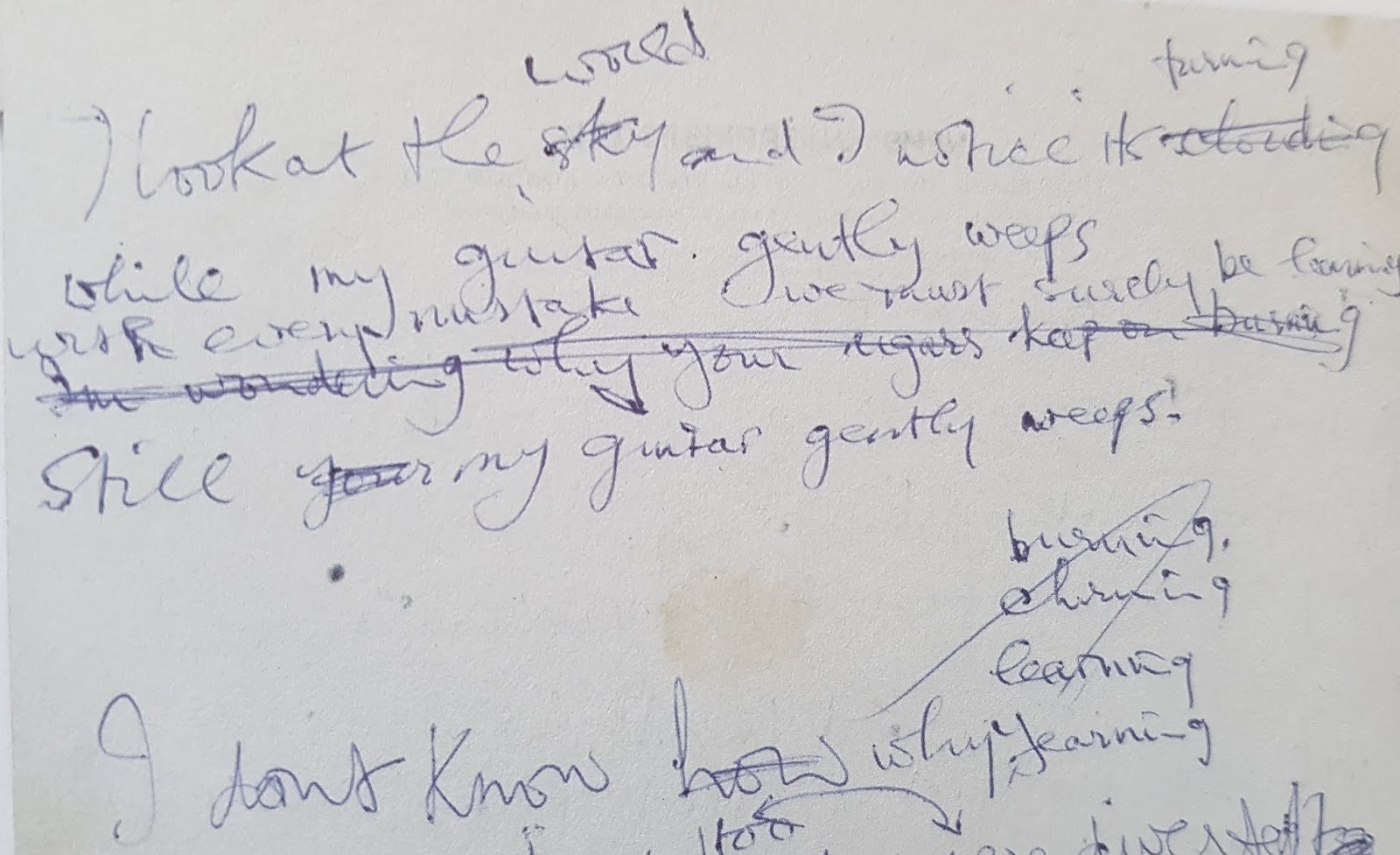
While My Guitar Gently Weeps


Written on 'NEMS London' headed paper While My Guitar Gently Weeps begins with a list of rhymes

Tampering – tapering, Tempering – thundering,
Tittering – Tottering, Towering, Toppling [TICK]
Wandering - Watering, Wavering, Weathering
Whimpering, wintering, whispering, Wondering [TICK]

and later on the manuscript

Burning
churning
learning
yearning

adding further supporting evidence that Harrison was suffering from a bad case of rhyme's disease when he penned this otherwise excellent song. The manuscript gives a window into the lyrical development. Verse 1 is fully formed but verse 2 develops from

I look at the sky and I notice it's clouding

which is then replaced by

I look at the world and I notice it's turning
While my guitar gently weeps
I'm wondering why your nigars[?*] keep on burning
still your guitar gently weeps! > still my guitar gently weeps!

[*Everett has it as 'cigars' but it certainly doesn't look like a 'c'!]


After the Burning/churning/learning/yearning list the lyric takes it's final form as

I look at the world and I notice it's turning
While my guitar gently weeps
With every mistake we must surely be learning
Still my guitar gently weeps!

I don't know how, someone controlled you, how they
blindfolded you.

Then the bridge undergoes a minor change

I don't know how
You were perverted – you were diverted too
I don't know why you got inverted
No one alerted you

as 'why' and 'how' change places

I don't know why
You were perverted – you were diverted too
I don't know how you got inverted
No one alerted you

George makes a number of attempts to start verse 3

I look at the powers around

I look at the wars of the world that are raging

I'm thinking of wars everywhere that is raging

I look at the trouble and hate that is raging

none of which he seems as happy with as verse 3 line 3

While I'm sitting here doing nothing but ageing

which is tweaked to

As I'm sitting here doing nothing but ageing

This verse survived to the Esher demo

I look at the trouble and pain that is raging
While my guitar gently weeps
As I'm sitting here doing nothing but ageing
Still my guitar gently weeps

by the time they got to Abbey Road (the 'Version 1' acoustic guitar/harmonium 'demo' that appears on Anthology 3 and 'Love') it's become

I look from the wings at the play you are staging
While my guitar gently weeps
As I'm sitting here, doing nothing but ageing
Still my guitar gently weeps

By the final version it's been replaced by a restatement of the first verse

I look at you all see the love there that's sleeping
While my guitar gently weeps
Look at you all
Still my guitar gently weeps


Birthday

After the section marked “SOLO” [1:28] is one called “STAGGERS” – the guitar/bass solo break [1:48]

Helter Skelter


An embryonic version of the 'jazz-style intro verse' is written after the 'do you don't you' verse supporting my theory that the intro was originally the chorus and the chorus was originally the bridge (or 'middle' as Paul notates it)

I go back to the top of the hill (ride)
And I stop and I turn and I give you a thrill
Till I see you again


Piggies

This is a post Esher version (in pencil) as it containing Lennon's line "Clutching forks and knives to eat their bacon" (Harrison had sung "Clutching forks and knives to cut their pork chops" on the demo). Mrs. Harrison's line "what they need's a damn good whacking!" is overwritten in red pen for emphasis!

There is also a cut 4th verse that George reinstated on the 1992 Live In Japan album.

Everywhere there's lots of piggies
Playing piggy pranks
You can see them on their trotters
At the piggy banks
Paying piggy thanks
To THEE pig Brother


Revolution

contains a Harrison-style list of rhymes

constitution
institution
desolation
revelation
pollution
dissolution
confusion
intrusion
distribution [?]
Constitution [?]


Glass Onion

Written on the back of an envelope, Glass Onion omits the word 'man' from the Walrus and me/close as can be lines and reveals that Lennon was even more ambitious about trying to cram in self-references

Trying to make a dovetail joint for a yellow submarine


The Continuing Story of Bungalow Bill

is titled '(the continuing story of) BUNGALOW BILL'


Hey Jude

She has found you now go and get her > You have found her now go and get her

The final version was only settled on very late in the recording sessions


Next: Recording Notes


Join the mailing list to get the free, exclusive, Beatles Songwriting Academy podcast!

Monday, 9 February 2015

Blessed Are The Drug Free (Or Why Bill Hicks Was Totally Wrong) - Extended Edition


Rubber Soul was our pot album, and Revolver was acid

If you believe drugs don't do anything good for us do me this favour; go home tonight, take all your albums and burn em, cos the musicians who made all that great music [were] real f**kin high on drugs. S**t, the Beatles were so high they let Ringo sing a couple of tunes. “We all live in a Yellow Submarine”? You know how f**kin high they were when they wrote that song? They had to pry Ringo off the ceiling with a rake to record that.

Great music + They were high = Drugs had a positive effect. Shall I walk you through it again?

Bill Hicks

It is a truth universally acknowledge that the Beatles took a lot of drugs. And the more drugs they took, the more original they became. You can even catalogue their albums by drug

John: Rubber Soul was our pot album, and Revolver was acid

Paul: For Sgt. Pepper I used to have a bit of coke and then smoke some grass to balance it out (MYFN p.384)

Drugs expanded their consciousness and informed their dress sense


George: In ten minutes I lived a thousand years...the only way I could describe it is like an astronaut on the moon...looking back at the Earth.

Ringo: It brought me closer to nature...my outlook certainly changed – and you dress differently, too!

It's also generally believed that drugs did them no real lasting harm. No one in the band OD'ed, drank themselves to death or even conked out on prescription meds*. To this day McCartney is a low-key poster boy for long term marijuana use.

Paul: Instead of getting totally out of it and falling over, as we would have done on Scotch, we'd [smoke pot and] end up talking very seriously and having a good time till three in the morning.

So it's odd to cite the Beatles as proof of the theory that recreational drugs are bad news for creativity, songwriting and a lasting career in music.

The Beatles made great music. Drugs helped them. But how much did it help? A lot or a little? Did it ever hinder them? And were the gains outweighed by the downside? Could they (or did they) gain the same benefit from other less chemical means?

Let's look at the evidence in three area - recording, writing and life in general.


Tuning up is a bit of a chore when you're stoned

Paul (MYFN p.192)

The Beatles used drugs far less often in the studio than is commonly believed

Geoff Emerick: The Beatles … rarely imbibed while they were working, and I certainly never saw any of them drunk in the studio (HTAE p.220)

Paul: most of our best stuff was done under reasonably sane circumstances...you've really got to get the miracle take if you're stoned. It can be done, just sometimes, but it may be one in a hundred (MYFN p.192-3).

Paul: We had a certain attitude towards EMI, that it was a workplace...you didn't want to mess around. That was our controlling factor. We didn't want to be lying around unable to do anything...Once or twice we'd try a little wine ... but generally you'd f*** up solos and you couldn't be bothered to think of a little complex musical thing that would have sounded great.

Ringo: We took several substances, but not when we were actually playing, because we found out very early on that if you play it stoned or derelict in any way it was really sh**ty music - so we would have the experiences and then bring that into the music later (SOL p.110).


Barry Miles: The Beatles... had a very workmanlike attitude to the studio ... they smoked pot...there were occasions where coke was available in the studio, but they avoided anything that would blur their musical awareness so there was no alcohol to speak of, and no heroin or acid. Most of their recording...was assisted by cups of tea, fish and chips or chinese takeaway, and maybe marijuana (MYFN p.191, 385).

Sometimes, however, they did get high in the studio but the result were generally poor. On Mar 21 1967, during the vocal sessions for Getting Better, Lennon accidentally took acid in the studio and had a bad trip, prompting George Martin to innocently take him up to the roof for some fresh air (MYFN p.191) In 1968, Driven mad by the never-ending Ob-La-Di, Ob-La-Da sessions Lennon left and returned high


“I AM F**KING STONED!!” John Lennon bellowed from the top of the stairs. Swaying slightly, he continued, waving his arms for emphasis. “I am more stoned than you have ever been. In fact, I am more stoned than you will ever be!” … And this,” Lennon added with a snarl, “is how the f**king song should go” (HTAE p.247). He launched into the piano intro with a vengeance providing the high point of an average song.

From '67 onwards Emerick posits their drug intake as the reason they were becoming “a bit complacent and lazy”

The Beatles turned up at the Studio...near midnight and spent... seven hours in a stoned haze, jamming endlessly... and pointlessly ... Lennon had brought a big strobe light in, so at one point they turned out the lights and started running around as if they were in an old film. That lasted for about five minutes, after which everyone started complaining of a headache. All four of them were completely out of it – tripping on acid probably – and it was the first Beatles session I'd ever attended where absolutely nothing was accomplished (HTAE p. 194, 197).

Ringo speaking many years later would concur

It was good to take the day before – then you'd have that creative memory - but you couldn't function while under the influence. When we did take too many substances, the music was sh*t, absolute sh*t (RR p.49) and You can listen to my records go downhill as the amount of medication went up (Express)

High or not, the sessions didn't descend into total chaos because the strung out musicians always had straight engineers and producers to capture the music

George Martin: There's no doubt that, if I too had been on dope, Pepper would never have been the album it was. Perhaps it was the combination of dope and no dope that worked, who knows? The fact remains that they often got very giggly, and it frequently interfered with our work (AYNIE p.206)


You and me chasing paper, getting nowhere

Maybe getting high while the tape is rolling is a bad idea. But what about when you're kicking back waiting for the muse to show up? Well the Beatles rarely wrote while high either.

Paul: we normally didn't smoke [pot] when we were working. It got in the way of songwriting because it would just cloud your mind up (RR p.51).

One time they did smoke pot was when writing The Word, an average (and not very trippy) song. When the time came to note the lyrics down, in true pot-head style they spent hours creating a multi-coloured illuminated manuscript with Paul adding a wash of pink watercolor, a tree and other abstract details.


No one knows where inspiration comes from but if we can work out the chemicals we could literally bottle inspiration. Drugs are a simplistic, lazy way of explaining the magic. Drugs can get us into a state vital for creativity – that of switching off the inner critic. But as any who has completed the FAWM challenge will know, being forced to write quickly will achieve the same results just as effectively.


Beer and Preludin - that's how we survived

Ringo Anthology

What beneficial effects did drugs have on the Beatles as creative people? Marijuana, alcohol and nicotine may have helped them relax but arguably the most helpful drugs the Beatles took were Benzedrine and Preludin, the Hamburg uppers found in cold inhalers and diet pills. These allowed the boys to cram their '10,000 hours' of practice into an insanely short period of time, learning stagecraft, analysing hundreds of great songs and evolving into the 'four-headed monster' able to survive the pressure of Beatlemania. Cocaine had a similar (but more limited) impact on Paul.

I did cocaine for about a year around the time of Sgt Pepper. Coke and maybe some grass to balance it out... eventually I just started to think - I think rightly now - that this doesn't work. You've got to put too much in to get too little high out it. I did it for about a year and I got off it (Uncut).

Lennon agreed

I had a lot of [cocaine] in my day, but I don't like it. It's a dumb drug. Your whole concentration goes on getting the next fix (AWAS).


Though Lennon always spoke well of LSD it seems to have had a devastating impact on him

I got a message on acid that you should destroy your ego, and I did. I was reading that stupid book of Leary's and ... I destroyed my ego and I didn't believe I could do anything. I let Paul do what he wanted and ... I just was nothing, I was s**t (LR).

According to Ian MacDonald acid left Lennon “a mental wreck struggling to stitch himself back together” (RITH p.193). On 18 May 1968 he called a business meeting at Apple to announce he was Jesus Christ. The next day while his wife and son were on holiday he invited Yoko Ono to spend the night at his mansion, recording the Two Virgins album, and beginning their relationship (RITH p.449). Lennon became addicted to heroin from the middle of 1968 to the end of 1969, partly in an attempt to wean himself off acid (BB).


Ringo by his own admission “got lost in a haze of alcohol and drugs” and missed most of the 1980's

I’ve got photographs of me playing all over the world but I’ve absolutely no memory of it. I played Washington with the Beach Boys – or so they tell me. But there’s only a photo to prove it (Express).

John had a similar but shorter bender, the infamous 'Lost Weekend' (1973-75), where he spent his evening in the Troubadour getting into a brawls, heckling comedians and sellotaping tampons to his forehead.

Harrison's self-proclaimed "naughty period” (1973–74) coincided with the breakup of his marriage, the Dark Horse album and tour. “Snorting mountains of cocaine to keep going” the drugs and constant touring “absolutely shredded” his voice (UCR/RS). Ex-wife Pattie Boyd said

That whole period was insane. Friar Park was a madhouse. Our lives were fuelled by alcohol and cocaine, and so it was with everyone who came into our sphere ... George used cocaine excessively and I think it changed him (WT).

Though undoubtedly more benign than other drugs, Paul's pot habit has arguably been a factor in the poor quality of his later solo output. Producer, Hugh Padgham (Press To Play) says

We'd stop for lunch and... he would go upstairs and smoke a joint...then he'd come down and sit there for hours trying to play the bass... the tedium. Oh! (FAB p.404).

In 1972 a drugs bust in Sweden prevented him touring Japan and the US. His Japanese drugs bust in 1980 and subsequent imprisonment also resulted in massive financial losses, cancelling Japanese and planned US tours (FAB p.363).


Did Dylan Thomas write Under Milk Wood on beer?

Remember the way Lennon categorised the albums by drugs? Here's what he actually said in full,

Rubber Soul was our pot album, and Revolver was acid. I mean, we weren't all stoned making Rubber Soul because in those days we couldn't work on pot. We never recorded under acid or anything like that. It's like saying, 'Did Dylan Thomas write Under Milk Wood on beer?' What the f**k does that have to do with it? The beer [and] the drugs are to prevent the rest of the world from crowding in on you. They don't make you write better. I never wrote any better stuff because I was on acid or not on acid (BI).

Crediting any Beatles song to the drugs they took is as almost as ridiculous as crediting Balzac's novels to caffeine or Zappa's albums to nicotine. It's is the person who happens to be a smoker, caffeine addict or crackhead who is really creating the art.

Quincy Jones: A little toke now and then never hurt anyone...but as [Charlie Parker] said, 'if you can’t play it’s not going to help you' (Telegraph).


Based on a novel by a man named Lear

The Beatles Bible asserts “LSD had a profound effect on The Beatles' songwriting and recording” and “there is little doubt that the Through The Looking Glass imagery was the product of drug intake”. But surely the primary source of Lennon's “Through The Looking Glass imagery” is Through The Looking Glass itself, a book Lennon revered. Likewise, though acid inspired Tomorrow Never Knows, the lyrics came straight from Timothy Leary reworking of the Tibetan Book of the Dead***, a book available to straight and high alike. As his childhood writings and published books prove**, influenced by authors like Edward Lear and Lewis Carroll and radio performers like Stanley Unwin and The Goons, Lennon was creating psychedelic prose long before he dropped acid. His later output owes more to the BBC than LSD.

The Beatles wrote songs about drugs (Yer Blues, Got To Get You Into My Life, Everybody's Got Something To Hide...) but that's not the same as writing on drugs. If you want to make a case for LSD helping you make music you have to do it from songs (like Ob-La-Di, Ob-La-Da and Getting Better) that were primarily written or recorded under it's influence. Acid trips provided the first two lines for I Am The Walrus but the rest came from Carroll, nursery rhymes and police sirens. A Day In The Life, Strawberry Fields Forever and Yellow Submarine all had similarly mundane origins.


To get really high you have to go it straight

George (RR p.54)****

The Beatles proved that recreational drugs have some benefits for creativity. But they also have a massive downside on life and mental wellbeing in general, and creativity and productivity in particular. Many, if not all, of the same benefits can be gained through limiting your options, writing to deadlines and reading great literature. As Frank Zappa said

I don't use any [drugs] and I've never encouraged it. The same state of psychedelic happiness can be induced through dancing, listening to music, holding your breath and spinning around, and any number of the old, easy to perform and 100 per cent legal means – all of which I endorse (EDQ p.68).


Footnotes

* Manager Brian Epstein died from an overdose of sleeping pills
** Lennon's published books In His Own Write (Mar 64) and A Spaniard In The Works (Jun 65) predate his acid use by 2-3 years.
***Timothy Leary and Richard Alpert: The Psychedelic Experience (1964)
****The full quote is “[Acid] can help you to go from A to B, but when you get to B, you see C. And you see that to get really high you have to go it straight” (RR p.54)

Sources

Bill Hicks - Watch the video here
MYFN - Barry Miles: Many Years From Now
HTAE – Geoff Emerick: Here, There And Everywhere
SOL – George Martin: Summer Of Love
RR – Robert Rodriguez: Revolver: How the Beatles Reimagined Rock 'n' Roll (see also this video for Ringo's quotes on drugs)
Express – Article: Ringo Starr At 70
AYNIE – George Martin: All You Need Is Ears
Anthology – Beatles Anthology Book (via Beatles Bible)
Uncut - Uncut Magazine July 2004 (via Beatles Bible)
AWAS - David Sheff: All We Are Saying (via Beatles Bible)
LR - Jann S. Wenner: Lennon Remembers (via Beatles Bible)
RITH - Ian MacDonald: Revolution In The Head
UCR – Ultimate Classic Rock
RS – Rolling Stone
WP – Wikipedia Dark Horse and I Am The Walrus
WT - Pattie Boyd: Wonderful Today
FAB – Howard Sounes: Fab: An Intimate Life Of Paul McCartney
BI - Beatles Interviews
Telegraph - Quincy Jones Interview
EDQ - Neil Slaven: Electric Don Quixote: The Story of Frank Zappa

Links

Other artists on drugs vs creativity


Friday, 20 June 2014

Guest Mini Book Review: While My Guitar Gently Weeps


Here's a guest review by BSA forum member Andy Getch. Enjoy.

While My Guitar Gently Weeps - The Music of George Harrison by Simon Leng (first published in the UK in 2003), review based on the Hal Leonard U.S. edition 2006.

Written after George's passing, this book chronologically follows George's musical story, but this is NOT a biography. I recommend it for a musician/fan of George Harrison, interested in his role in The Beatles and the evolution of his solo career.

The Good

There is something here about nearly (do I dare say every?) recorded published track here, even obscure B-sides and side projects. Musicians and instruments are listed for each song and summarized with a fair bit of information, with comments on the story, arrangements, etc. typically included. This is a musician's book about a musician. It generally keeps that focus, providing quotes from other musicians and detail in musical terms.

The Not So Good

The "unappreciated Beatle" refrain gets old after awhile. Only the first 40 or so pages of the 330 pages in the book are devoted specifically to George in the Beatles years. The same amount of ink is devoted to the late 60's solo project Wonderwall Music and All Things Must Pass. References and comparisons to Beatle days are sprinkled through the rest of the book. There is a fair bit of ink devoted to George's spiritual journey and how it influenced his music. That may put some people off.

Andy Getch is 6th year hobbyist guitarist songwriter and lifelong Beatles fan.

More Book Reviews here


Saturday, 9 March 2013

Solo Beatles


The White Album has gained a slightly unfair reputation as being merely a collection of Beatles solos tracks, but it does contain some, along with 3 other albums.

Allow me to take a post to test your knowledge dear readers.

In the 211 official tracks there are only 9 songs featuring a solitary Beatle - one each from Ringo, George and John and a massive 6 featuring only Paul.

OR to look at it another way

6 appear on The White Album
1 each on Sgt Pepper, Abbey Road and Help

and as a bonus question can you name ANY of the seven tracks that appeared on an official UK Beatles release that featured NO Beatles at all?

PLEASE don't leave any comments here. Once you think you know the answers click here to check and leave a comment.


Wednesday, 28 November 2012

10:10 I'm So Tired (pt.2)


The Melismatic Madrigalistic Mystery Tour

Last time, I characterised I'm So Tired as a throwback to an earlier standard of writing for Lennon. One very clear blast from the past is the return of melisma, the technique of stretching one syllable over many notes. Melisma is all over early Beatles albums like a rash

Misery: “treating me ba----d”
All I've Got To Do: “Whenever I------”
Hold Me Tight: "It's you, you you----"
I Wanna Be Your Man: "Ma-an!"
and Not A Second Time - all over the place!

But it all but vanished from later work, the only real example that come to mind is Because “it turns me on------”.

Here though it really emphasises the drowsy subject matter, stretching out “I'm so-o-o-o tired” like one long yawn. The effect is even more pronounced when he slides down from a B to a G# on the second verse “I'm sooooo tired”

Madrigalism

In fact the whole song is great example of madrigalism (Ticket 49), the stretched out lazy rhythm of the vocals and the drop from the root chord to the (out of key) VII chord

I'm so (A) tired (G#7)

makes it sound as though he's sliding down the wall as he slips into unconsciousness.


Melody

There's a lot of originality in the melody too. Lennon stays off the root note, hardly ever coming to rest (geddit?) The melody starts very unusually on the 2nd degree of the scale (ticket 50), the 2nd verse slide (see above) misses the root note out altogether and John uses other non-chord tones (ticket 13) as well, mainly singing lots of B's over D chords (6th).

In fact the whole song avoids camping out on the root. At the end of the verse the melody lands on the root, but over a Dm chord (the legendary iv or minor 4 chord) and at the end of the chorus we get the root chord A major but Lennon stubbornly keeps singing an E (the 5th). Apart from a solitary incident of b3rd blue notes, (ticket 22) on “no no no” the melody is completely diatonic giving a great example of ticket 14 – write in key melody over out of key chords. (We'll look at those chords next week).

Lyrically, we have some parallel lyrics (ticket 24)

I wonder should I - get up/call you
my mind is – on the blink/set on you

and straight repetition (I'm so tired on line 1 and 2) which adds to the stickiness, but the jewel in the crown is the humorous rhyming of cigarette/stupid get*, which should be enough to earn Lennon the title of 'Scouse Cole Porter'. It's something that the Arctic Monkeys did well on their first two albums, most notably coupling 'Ford Mondeo' with 'have to say owt' on When The Sun Goes Down.

Lennon sings “my mind is set on you” which is a weird phrase, especially when you think that 19 years later George Harrison went on to cover Rudy Clark's 1962 song Got My Mind Set On You.

Coincidence or something more sinister?!?!?!**

*If you're wondering 'get' is the Liverpool pronunciation of the English word 'git' which is roughly equivalent to the American 'S.O.B'.

**It was a coincidence, obviously. And yes, Paul is still alive.

Saturday, 28 January 2012

Here Comes The Son (With A Lost Solo)

Here's a treat for you - Dhani, George and Giles finding a unused solo in the Here Comes The Sun master tapes


 Thanks to And Pop


Wednesday, 4 January 2012

10 Preconceptions About The Beatles (pt 2)

In my last post I listed a few preconceptions I had when I started this blog two years ago. Let's see if I was right...


1) The Arctic Monkeys are better songwriters than the Beatles

WRONG – Arctic Monkeys were another young British band with regional accents and cheeky sense of humour whose sudden rise to fame looked like something akin to Beatlemania. The big difference was that, in Alex Turner, they had a lyricist with the wit and sharp eye of a young Dylan and they burst onto the scene with a fully realised sound/style. When they survived the hypestorm almost completely unscathed and delivered an assured and mature second album without pausing for breath (along with another albums worth of quality B sides and EPs) it looked like they were unstoppable.

But 2009 changed all that. Album number 3 was largely dour, turgid and overly influenced by producer Josh Homme and I had started listening to the Beatles. Arctic Monkeys are a great band, far better lyrically than The Beatles and quicker to mature in the studio, but they need to turn in another 8 or 9 incredible albums that continue to develop and stretch to claim the crown, and sadly that doesn't seem likely to happen.

2) Judging the Beatles for trite lyrics is merely a result of unfairly comparing song lyrics to printed poetry

WRONG - Compare any song lyrics to poetry by putting them side by side on a page or even read them aloud and the lyrics are guaranteed to come of worse. BUT. Many of the Beatles lyrics are undoubtedly poor, even when compared to other pop song lyrics. The truly awful outnumber the excellent, and the average and mediocre outnumber both. There's hundreds of better lyricists out there - Paul Simon, Bob Dylan, Bruce Springsteen, Nik Kershaw, Tom Waits, Leonard Cohen – the list goes on and on and on...


3) George Harrison could have been as good a songwriter as Lennon and McCartney (and was later) but wasn't given a fair chance

WRONG - This assumption came from two things, Harrison knocking the ball out of the park on Abbey Road with Here Comes The Sun and Something and the fact that his first post Beatles album was a critically acclaimed TRIPLE album! While Harrison compared his time in the Beatles to a 7 year bout of constipation (which I guess would make All Things Must Pass a giant diarrhoeic bowel movement) the general perception is that ATMP was a mix of classics and filler (think Use Your Illusion). I don't have an opinion as the album is still on my 'to do' list, but even if it was a 24 carat disc, the next album of originals didn't arrive till 3 years later and Harrison only managed 7 more solo albums in the next 27 years.

We could indulge in 'What If' scenarios (that's what comments sections are made for!),

Lennon/McCartney/Harrison? – too many chiefs in the kitchen
Lennon/Harrison? – too similar, an overdose of dark cynicism that would make Roger Waters sound like The Wiggles
McCartney/Harrison? – might have worked. But would we have lost out on Lennon/McCartney songs? And surely Paul would have driven George crazy? (see Let It Be for further details)

but whatever may have been, George was never in John and Paul's league. Harrison's songwriting career didn't start till Dec 63 with Don't Bother Me and then nothing happened for another 18 months. Lennon and McCartney just had too big a head start. I think it's comparable to Dylan, Springsteen and Bon Jovi. Each are good writers in their own right and genre, but if Bon Jovi had been in Springsteen's band or Springsteen in Dylan's they would never have been able to compete and would never have developed. (OK, maybe that's a poor example!)


4) John Lennon gave up songwriting to be a house husband and was just coming into his prime when he was killed

WRONG - I'm not even going to get into the whole 'was Lennon really baking bread and reading bedtime stories or just having a Brian Wilson-style drug-fuelled hibernation?' debate. It's sufficient to say Lennon's solo career was hampered by the same laziness and apathy that plagued his work with the Beatles and his resurgence, while very welcome, produced yet another mix of promising songs and Yoko's experimental crap swimming in bland, middle of the road production. The posthumous leftovers Milk And Honey only promised more of the same.

What do you think? Am I right now?
I'll look at the remaining 6 assumptions next time.

Sunday, 4 December 2011

Fight! Fight! Fight!


If you're reading this sometime after 1pm on monday you can head over to steampunk visionary Tom Slatter's Indiesongwriter.net blog and witness me and Tom duking it out over whether The Beatles are the best band for songwriters to study.

And here's one of Tom's cool futuretro videos The Beast of the Air to keep you going till then


Wednesday, 5 October 2011

Film Review: Living In The Material World

Still A Dark Horse


A documentary on a music celebrity can be measured by content and insight - what footage did they access and who was willing to contribute and what new light did it shed on the subject? On the first point Martin Scorsese knocks the ball out of the park. Though I didn't feel I knew George any better than before by the end, I was treated to nearly four hours of dazzling and emotionally moving entertainment.

I watched both parts of the film at UK preview and at no point did my attention or enthusiasm flag. In fact I would have happily sat through any outtakes! This beautifully crafted film is packed with concert footage, home movies, press conferences, interviews, photos and documents that I've never seen before, even though I've been researching the Beatles quite heavily for several years here at Beatles Songwriting Academy. There are interviews with (or at least footage of) everyone you would hope to see. Beatles, wives, brothers, son, Pythons and peers. Everyone from Eric Clapton to Eric Idle.

The documentary is constructed entirely from interviews and clips without explanation or analysis. The closest we get to a voiceover is Dhani Harrison reading excerpts from his father's diary and letters to his mum. Though the film is visually stunning it's strange watching the practically square picture forced upon us by the source material. Equally quirky is the sound editing. Scorsese doesn't know the meaning of 'fade'. All the music cuts brutally, sometimes after a few seconds. Sometimes this is cool. Mostly it's odd. The film is largely chronological and there are some great juxtapositions of sound and visuals like All Things Must Pass accompanies footage of the WW2 bombers that plagued Liverpool during Harrison's birth. The first part covers George's life up to the White Album.


It's hard to pick out favourite parts. But Harrison's obvious delight watching archive footage of the Beatles miming This Boy, laughing and singing along, is one. The Beatles performing If I Needed Someone, Harrison playing What Is Love? with Billy Preston, and seeing the Travelling Wilburys in the studio would be others.

There are moments of laugh out loud humour, especially TV footage of crusty professors discuss the significance of Pop music while Beatles and Mick Jagger seeth like captive wild animal in the background and Tom Petty recounting Harrison arriving at his house with a trunk full of ukeleles. But Harrison's story of how Lennon and McCartney inspired him to start composing is the best -

"If John and Paul can write [songs] everybody must be able to".

The Maharishi (a spiritual Joe Pasquale) and Phil Spector (a croaking, unblinking vision of craziness with a permanently twitching thumb) also provide some unintentional humour.


Scorsese deserves praise for not going down the revisionist myth making route trodden by the Anthology series, especially as Olivia Harrison was one of his producers. Olivia is honest, though vague, about George's infidelity as Klaus Voorman is about his drug problems. But the lack of a narrator almost makes George a mirror in which we see his world. We know he was loved, deeply, by friends - racing drivers, comedians and film makers, musicians, but we don't whether he was truly loveable. Terry Gilliam describes George as a mix of "grace, humour and a weird kind of angry bitterness" but what made him that way? Did he ever find a release from that bitterness? Was he a good father? Nearing death Harrison asked Olivia if he had been a good husband. She never tells us what her answer was."What's the secret of a long marriage?" She asks herself. "Don't get divorced".

It may sound strange but the highest point for me was simply hearing the music. Listening to Here Comes The Sun and While My Guitar Gently Weeps I was almost moved to tears at the transcendent beauty of those recordings.

Perhaps the fact that the film cause me to fall in love with the music all over again is it's greatest recommendation.

Something In The Way He Makes Movies


Just got back from a UK cinema preview of Martin Scorsese's mammoth (almost four hours) documentary George Harrison: Living In The Material World. Really enjoyed it. Stay tuned for a review....

Wednesday, 23 March 2011

12:21: George Harrison Wants Me For A Sunbeam (Here Comes The Sun)


Abbey Road is a dizzying mix of Beatles songwriting, from McCartney's career low point to arguably Harrison's best song. Abbey Road showcases a genuinely happy sounding Harrison devoid of the grumpy hectoring or more-enlightened-than-thou attitude that blights many of his other songs. Here Comes The Sun is a lesson in perfect balance between the verse and chorus on one hand and the bridge on the other.


The verse & chorus have an almost childlike simplicity – the melody is nearly all conjunct, wandering gently up and down a very small part of the major scale (5 notes), sticks closely to chord tones, no blue notes and nearly every phrase starts on the 2nd beat or the and after one. Chord wise the verse progression is

A A D E7

where the bulk of the chorus is

A A D B7

The song is full of lyrical parallels (Ticket 24) and straight repeats. We get the verse 4x (though the first verse is instrumental) and the chorus 5x.

Every line of the verse starts with Little darling, we get Here comes the sun twice in the chorus (by way of a change we get sun, sun, sun, here it comes 5x in the bridge!). Throw in It seems like years since it's been here/clear and it feels like/I feel that and we're dealing with a very limited lyrical palette.

Imagine the song without the bridge. For all it's catchiness and feel good mood it would get tiresome. But the bridge is left of centre enough to keep the song fresh without adding yet another ill fitting medley to Abbey Road (Ticket 5) .


  • The V&C are mainly diatonic but the bridge has some solid out of key moments (C & G the bIII and bVII respectively). 
  • The V&C are in 4/4 but the bridge uses odd time signatures - 3/8 and 5/8 (Ticket 15). 
  • And overall we have a folky V&C compared with an almost prog rock style bridge.


More on Here Comes The Sun next time...


Thursday, 6 May 2010

Coverville, George Harrison & the Legend of the Templeton Twins


There's an interesting podcast called Coverville that feature covers of famous songs by other famous (and not famous) bands. The episode on George Harrison (555) has a nice mix of Beatles and solo stuff (check out Show Of Hands doing If I Needed Someone) but nothing could have prepared me for the psuedo 1920's version of Something by (are you ready for this?) 

The Templeton Twins 
backed by Teddy Turner & his Bunsen Burners. 

What struck me (apart from the hilarious poker faced arrangement) was how easily the song translated into a jazz crooner vehicle with so little reharmonisation.

 But the plot thickens. The album Trill It Like It Was is long out of print (in fact I'm not sure it's ever appeared on CD) so I did a little research. It turns out The Twins are better known as Van Halen producer Ted Templeman!!!


Here's one other Beatles Templeton/man cover I managed to track down.