Showing posts with label White Album 50th Anniversary. Show all posts

Wednesday, 13 May 2020

10:68 Ob-La-Di, Ob-La-Da (pt.2) Four Beatles In Search Of A Groove


Written in Rishikesh and originally titled Obla Dee Obla Da, the received narrative about this song is that Lennon hated it and furiously forced it over the finish line, propelling the band at breakneck speed with his drug-crazed piano playing.

McCartney was always the musical visionary who could complete what Lennon started but on this song the tables were turned. For once McCartney was at sea musically and it was Lennon that came to the rescue.

A walk through the different versions reveal a clear plan and stunning failure to execute it.


  • Esher demo
  • Version 1
  • Version 2 – this is the version on The White Album
  • Version 3 – abandoned after a couple of takes and unreleased


All version were played in A but on the Esher demo the guitars are tuned down a semitone to Ab and on version 2 the tape is varisped up a semitone to Bb.

That the song was always intended to be a ska-influenced recording is clear. Calling the song "one of the first examples of white reggae" Stewart Copeland says, "Ob-la-di has an accent, ob-la-da has an accent, 'life goes on...' sort of leads you into that ska feel. There's a definite scansion to those lyrics, which is probably why they ended up playing a ska beat"*. Paul's lyrics and ska-approved vocal percussion "chicka-bum" and Lennon's studio comments "Oobladi-blada. Brutha!", "Yassuh! Take one, and de Mighty Jumbo Band!” show their heads were somewhere more tropical than St. John's Wood, NW8.


Version 1 has been released as an Anniversary Edition bonus track ('Take 3') and on Anthology 3 ('Take 5'). The latter features the (uncredited) creator of the chorus lyrics, Jimmy Scott Emuakpor on congas.

Perfection is attained not when there is nothing more to add, but when there is nothing more to take away.*
Antoine de Saint-Exupéry


The Esher demo and Take 3 feature very straight ahead drumming and strumming – the only hint of ska is the chord fill in the bridge (1:29).

Take 5 (the same take with overdubs) add a lovely tiny cowbell, some busy sax parts, Jimmy's very busy congas and Paul's extremely busy bass.

There is zero groove at this point - no skanking* from guitar or piano and ultra 'white bread' drumming. The bass runs all over the place and the only semblance of a groove comes from congas and cowbell patterns that are messy and confused. The whole thing is a hyperactive hot mess, the result of adding more and more to a track that isn't working. Ringo has no idea what to play and McCartney, uncharacteristically, isn't able to help. Geoff Emerick stated the obvious saying "Paul wasn't happy with the rhythm of the track … he was after a Jamaican reggae feel and he wasn't satisfied that the band had nailed it"* but then went on to tell the tale that has become legend.

When Paul announced he wanted to … start the song again from scratch, John went ballistic. Ranting and raving, he headed out the door, with Yoko trailing closely behind, and we thought that we'd seen the last of him that evening. But a few hours later he stormed back into the studio, clearly in a highly altered state of mind.

"I AM F**KING STONED!!" John Lennon bellowed from the top of the stairs … swaying slightly, he continued, waving his arms for emphasis. "I am more stoned than you have ever been. In fact, I am more stoned than you will ever be! … and this," Lennon added with a snarl, "is how the fucking song should go." Unsteadily, he lurched down the stairs and over to the piano and began smashing the keys with all his might, pounding out the famous opening chords that became the song's introduction, played at a breakneck tempo.*

Truth From Fiction


Lennon didn't play the song "at a breakneck tempo". Version 1 was recorded at 121bpm. Version 2 is only 112bpm even after varispeeding up. It was played at 107bpm – significantly slower. Lennon didn't speed the song up, he slowed it down to a tempo that allowed to song to breathe.

Side stepping the fruitless search for 'authenticity' he played what Ian MacDonald describes as a "mock music-hall piano"* intro giving it an instant instrumental hook (Ticket 3), before playing what the song had been crying out for all along the 2, 4 skank pattern. He was incapable of overplaying as McCartney and Emuakpor had been doing and Lennon's limitations as a piano player saved the track. Harrison fell in with a similar rhythm on acoustic guitar and Paul created a new, simple grooving bass line built on arpeggios on 1 2+ 3 4+. And Ringo ? Ringo played the same beat as before. But you can't have everything.


Once the track locked together, other ideas presented themselves. Compare the improvement in the rhythmic accompaniment on "Desmond and Molly Jones" from Version 1 (1:21 – Take 3, 1:23 - Take 5) to the Lennon-driven remake (1:30). There are some childlike plinky piano overdubs (2:32) and a sped-up gliss that sounds like a video game (2:08). McCartney's bassline deserves special mention, using a distorted acoustic guitar (0:02) to doubling the very simple bass line, Paul plays both instruments with a plectrum, adding funky ghost notes on the bass (0:06) that really make the song move.

Mind Blown


It's understandable that Paul would listen to Reggae/Ska and subconsciously absorb melodic ideas. So it forgivable that the start of the bridge has the same melody and almost exactly the rhythm as the opening line of River of Babylon by The Melodians.

In a couple of years
A A D D E F# (landing on a D major chord)

By the rivers of Babylon
D D G G A B B B (landing on a G major chord)

But here's the bombshell. Paul's song was released two years earlier! Did the Beatles have a influence on the seminal 1970 song?*


Footnotes

One of the first examples of white reggae
Stewart Copeland: Musician Magazine (1988)

perfection is attained
Antoine de Saint-Exupéry: Wind, Sand and Stars (p. 31)

Paul wasn't happy with the rhythm
Geoff Emerick: Here, There and Everywhere (p.246)

Skanking
Sharp off beat chord hits which are the foundation of reggae & ska (on beats 2 and 4 in reggae and the 'ands' between beats in ska).

Paul wanted to start the song again from scratch
Geoff Emerick: Here, There and Everywhere (p.247)

Mock music-hall piano
Ian MacDonald: Revolution In The Head (p.295)

Seminal 1970 song
It was a no 1 hit in Jamaica on release and reached an international audience via The Harder They Come Soundtrack which is credited with having "brought reggae to the world" (L.A. Times).


Friday, 3 April 2020

10:65 Revolution (pt.5) - Don't Bore Us, Get To The Pre-Chorus


*N.B. All timings are for Revolution 1 unless otherwise stated.

Revolution has some great songwriting tips to give us and a lot of them are contained in the pre-chorus. If great songwriting is a matter of tension and resolution, much of the tension is here.

Here's an experiment – grab your guitar and play the song, omitting the pre-choruses. Structurally it still works and even the narrative flow still hangs together. But it just ambles along, three chord wallpaper.

So how do the pre-chorus do that voodoo that it do so well?


Gimme Five


Firstly like all three sections it ends by building on the V chord (even the single-only piano solo does it – 2:03). Ticket 65 (in it's most extreme incarnation the "aaahhhh" section of Twist and Shout) appears in the verse as we hang there for two bars to gently build anticipation (0:43). On the chorus we enjoy a cool guitar break, again built on the V (1:16). But in the pre-chorus it's a proper build up (0:59), not only used to create a lift back to the chorus' tonic chord but also to reset our ears and restate the key after the F# chord (0:56).

Something Sounds Fishy


Let's talk about F#. First of all it's completely out of key chord (Ticket 28) providing the freshness and surprise that OOKC's do. But occurring near the end of the section it seems to be setting us up for a big key change. Where are we going next? The excitement is palpable! Though Bm and E are still in the home key of A the pre-chorus hints that Bm might be becoming the new key centre. The G and A chords that follow are firmly in the key of Bm and F# is the V of i (translation = an F# major chord leads REALLY strongly back to Bm, even though technically F#m is the chord that belongs in that key). And the Beatles have used that trick hundreds of times – While My Guitar Gently Weeps (0:29), Because (0:39), Girl (0:09), I Me Mine (0:29), I Want You (She's So Heavy) (1:44) I'm Only Sleeping (0:08) etc.

The vocal melody at this point is hanging on an A# (count me OUT) which if you're in the key of A major is about as nasty and weird as you can get but if you're transposing to Bm it's the 'leading tone' (7th) - the smoothest path you can take.

So we're heading to Bm, right? Nope. Lennon chooses the 'real' V chord (E major) and takes us back to A major. Why? Because he doesn't want to change! Revolution is an anti-revolution song, remember? Don't you know? It's gonna be alright!

Cos when you want a transposition
Don't you know that you can count me out!

I Asked My Cat Who His Favourite Socialist Was ...


He just looked at me and said Mao.

Lennon reserves his most forceful arguments for the pre-choruses. Not only through his use of humour (the Chairman Mao lines), but in the way the whole band punctuate the polemics and gags. Listen to the way the band let the vocals take centre stage. On the single (0:34), guitar and bass drop entirely (Ticket 30), on the album (0:48) sustained chords from the guitar and horns allow the lyrics room to breathe.

Lennon may have played to both political sides on the album version, but listen to how the chords change on every word (0:55) to ram home the message "COUNT (G) ME (A) OUT (F#)". This (Ticket 36) is a powerful way to make your point in a song, in comparison John's [count me] "in" sounds like a weak afterthought once the band are pounding away on the F# chord.

The way Lennon develops the different pre-chorus vocal lines deserves credit too. PC 1 employs the same "lah-di-dah-di" (long-short-long-short) shuffle rhythm that vocals, drums and guitar play in the verse

"don't-you / know-that / you-can"

but PC 2 and 3 up the tension by using a faster triple time rhythm (not technically a triplet as we're in 12/8 time but it's essentially the same thing)

if-you-want / mo-ney-for / peo-ple-with
All-I-can / tell-you-is / bro-ther-you'll

So as well as upping the urgency from the first set of lyrics by adding more rhymes (see previous post) he's building by having a more insistent, busier rhythm. This development from one pre-chorus to the next is a mark of a true craftsperson, sorely needed in today's copy-and-paste era, where each section is literally a clone of an earlier ones (albeit with ever-increasing overdubs).

These later pre-choruses provide a contrast to the laid back rhythm of the verse and chorus. The chorus vocals are an octave higher than the other sections. If you map the vocal line out like this

V – low and laid back
PC – low and busy
C – high and laid back

you can see how distinct each section is.

Finally, one detail that's easy to miss is the way Paul staggers the piano chords in the pre-chorus, playing on the 'and' after 3. It's inaudible on the finished mix (0:49) but clear on Take 18 - the 50th Anniversary 'outtake' (1:00).

Next time we'll finish our look at the 'Revolution twins' with mistakes, odd timing and unusual choices.


Monday, 8 July 2019

While My Guitar Gently Weeps: Anniversary Edition Notes


While My Guitar Gently Weeps was one of the few post-Rishikesh songs on The Beatles.

Lyrical Development


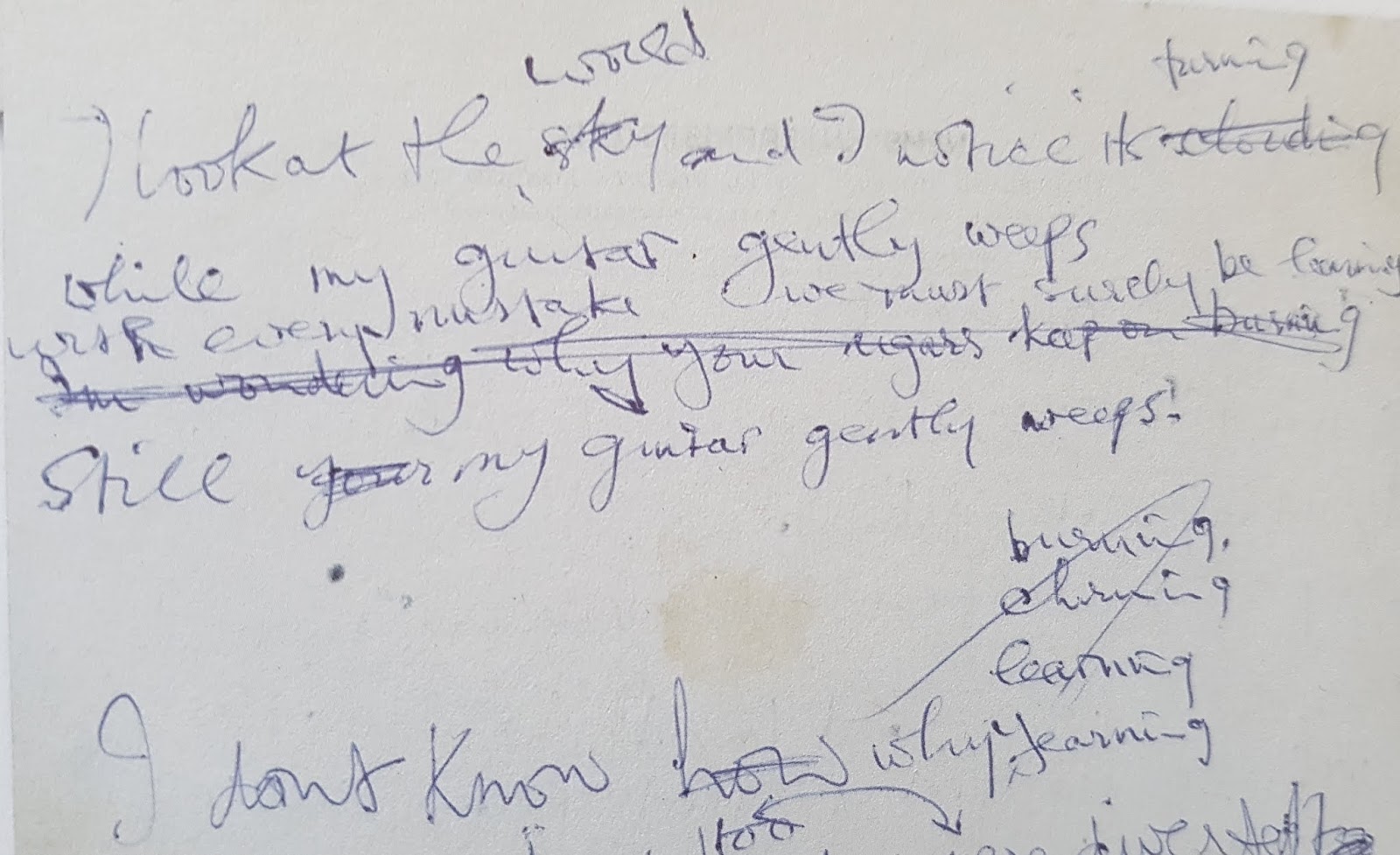
The lyric facsimiles in the anniversary edition, written on 'NEMS London' headed paper, begins with a list of rhymes

Tampering – tapering, Tempering – thundering,
Tittering – Tottering, Towering, Toppling [TICK]
Wandering - Watering, Wavering, Weathering
Whimpering, wintering, whispering, Wondering [TICK]

and later on in the manuscript

Burning
churning
learning
yearning

adding further supporting evidence that Harrison was suffering from a bad case of rhyme's disease when he penned this otherwise excellent song.

The manuscript gives a window into the lyrical development. Verse 1 is fully formed but verse 2 develops from

I look at the sky and I notice it's clouding

which is then replaced by

I look at the world and I notice it's turning
While my guitar gently weeps
I'm wondering why your cigars [?*] keep on burning
still your guitar gently weeps! > still my guitar gently weeps!

After the Burning/churning/learning/yearning list the lyric takes it's final form as

I look at the world and I notice it's turning
While my guitar gently weeps
With every mistake we must surely be learning
Still my guitar gently weeps!

I don't know how, someone controlled you, how they
blindfolded you.

Then the bridge

I don't know how
You were perverted – you were diverted too
I don't know why you got inverted
No one alerted you

undergoes a minor change as 'why' and 'how' change places

I don't know why
You were perverted – you were diverted too
I don't know how you got inverted
No one alerted you

George makes a number of attempts to start verse 3

I look at the powers around

I look at the wars of the world that are raging

I'm thinking of wars everywhere that is raging

I look at the trouble and hate that is raging

none of which he seems as happy with. Verse 3 line 3 is more solid, needing only minor tweaks

While I'm sitting here doing nothing but ageing > As I'm sitting here doing nothing but ageing

This verse survived to the Esher demo

I look at the trouble and pain that is raging
While my guitar gently weeps
As I'm sitting here doing nothing but ageing
Still my guitar gently weeps

by the time they got to Abbey Road (the 'Version 1' acoustic guitar/harmonium 'demo' that appears on Anthology 3 and 'Love') it's become

I look from the wings at the play you are staging
While my guitar gently weeps
As I'm sitting here, doing nothing but ageing
Still my guitar gently weeps

By the final version (Version 3) it's been replaced by a restatement of the first verse

I look at you all see the love there that's sleeping
While my guitar gently weeps
Look at you all
Still my guitar gently weeps

Musical Development

In a similar way the demos and recording notes chart the musical evolution.

Esher demo


  • The key is F#m (Dm capoed at 4th fret)
  • The tempo faster
  • The vocal rhythm is more straight forward and hurried
  • There's a short i to bVII (F#m – E) vamp after the last bridge missing from the finished version
  • At the end of each bridge phrase there's a V to V+ substitution but played inconsistently and not always by both doubled-tracked guitars – revealing it to be an idea that George was perhaps considering but not committed to.

Version 1

The key is Gm. It's still played in Dm but now capoed on the 5th fret. Perhaps the Esher was capoed at 5 too but tuned down a semitone like most of the other demos?

Paul is playing minimal harmonium on the bridge and a few other spots.

The previously undiscovered 'Take 2' outtake has Paul switching to organ but still very much figuring out the chords.

Version 2

According to the studio notes this had John on organ and Paul on bass. Bizarrely the notes state the tape was slowed down by three semitones. From what? If the key had already risen to Gm and was destined to end up in Am it seems strange to start going down again. Three semitones would put the song in Ebm.

Perhaps it's a mistake – three down from the final key Am would put the song back in the Esher key – F#m. Maybe someone is getting their versions mixed up. Until they release a version 2 outtake (anyone out there have one? Send me a link!) we can't be sure.

Version 3

The 'third version take 27' outtake makes it clear the line up is


1 Ringo drums
2 Eric Clapton jamming freely throughout the take on 'Lucy' - the Les Paul he gave to George a month before the session.
3 Paul switching live between piano (intro/verses) and organ (bridges)
4 George on acoustic and George and Paul on vocals

George is attempting Smokey Robinson falsetto/melisma thing that makes him sound like a hypothermic sheep – he halts the take saying “I tried to do a Smokey and I just aren't [sic] Smokey”

Overdubs: George double tracked his vocals and adds more organ (0:58, audible on top of the piano during the guitar solo and continuing for the rest of the song) Ringo adds tambourine and weird sounding tippy-tappy percussion (left speaker 0:34) and there's a distorted bass part played by … who? McCartney on bass (BB) or Lennon on Bass VI (50AE)? It can't be both as the only 'bass' is overdriven and played with a pick.

The case for John

The part, like so many of John's Bass VI performances, is very much a guitar part down an octave, switching between power chords and free flowing single notes riffs rather than diligently performing the role of bass man. Though very un-bass-player-like it's John's best 'bass' performance by a mile.

The case for Paul

From Pepper onwards Paul often overdubbed his bass afterwards. When John played bass, it was usually because they needed it on the basic track and Paul was playing something else (like piano on Long And Winding Road). Here John didn't play on the basic track at all so there was no need for him to play bass – the 'real' bass player could do it. It's likely Paul used his Rickenbacker not the Bass VI (RITH) as the Beatles only had a right-handed one.

If Lennon had provided the Bass VI part it's hard to believe Paul would have been able to resist added a 'real' bass track underneath (as he had done on Back In The USSR). And while it is very 'free' the playing is also tight and disciplined, which is more of a Paul trademark.

The Electric Guitar Mystery – Solved?

Allegedly Lennon is on rhythm guitar (BB) or lead guitar (RITH) but the only electric guitar on the finished track is Clapton switching effortlessly between lead and rhythm.

It used to be thought that Lennon's lead guitar was tracked on the 5th Sep and replaced by Clapton's overdub on the 6th (TBRS). How Clapton's presence was supposed to 'make everyone act better' (as Harrison later stated) when their work on song was already completed is unclear and the outtake answers that - Clapton tracked his part live with the band (on the 5th).

Paul on bass and Eric on guitar leaves John having contributed nothing to the track, but he often absented himself from George's songs so it's a plausible theory.


*According Everett to but it looks more like an 'n' than a 'c' to me!

Sources

50AE: The Beatles 50th Anniversary Edition Book
RITH – Ian McDonald: Revolution In The Head
BB – Beatles Bible
TBRS – Mark Lewisohn: The Beatles Recording Sessions


Join the mailing list to get the free, exclusive, Beatles Songwriting Academy podcast!

Friday, 5 July 2019

Wild Honey Pie and The Continuing Story of Bungalow Bill: Anniversary Edition Notes


Wild Honey Pie

Was recorded during the Mother Nature's Son sessions and titled 'Ad Lib' Take One on the track listing.

The Continuing Story of Bungalow Bill

A post-Rishikesh lyric manuscript is titled (the continuing story of) BUNGALOW BILL has the following vocal performance direction above the title

“Band (Water Melon). Children!”

possibly a (faintly racist?) reference to the band singing backing vocals?

On the Esher demo the tuning is down a semitone (again), the intro chord progression is (possibly accidentally) C Fm C instead of C G C and timing is slightly different. At the end of each chorus chord sequence we get one extra beat instead of two. And the “All the children sing...” rhythm is different.

On the outtakes on unused take 2 Lennon sang “Was it a thrill, Bungalow Bill?” and Ringo is playing with brushes and still making his mind up about the feel.

Paul used up two precious tracks for two bass parts but John replaced the second with a vocal overdub; John, Paul and George can all be hear whistling at 2:45 and Ringo the backing vocalist gets a rare outing.

I've long held to the view that John's cry of 'Ay Up!' belongs at the end of this track NOT at the beginning of While My Guitar... that's confirmed here by Giles' remix which restores it to it's rightful place (as it is on the mono version).


Join the mailing list to get the free, exclusive, Beatles Songwriting Academy podcast!

Wednesday, 29 May 2019

Ob-La-Di, Ob-La-Da: Anniversary Edition Notes


Ob-La-Di Ob-La-Da appears in Paul's “Spring Songs: Rishikesh 1968” notebook titled 'Obla Dee Obla Da'. The Esher demo like all other versions is played in A but tuned down a semitone like many of the other demos. Paul harmonises nicely with himself. There's some percussion and someone is shaking a axatse/shekere/calabash.


The coda spends only one bar on the vi chord (3:00) to the finished version's two bars.

The track listing reveals that Version 1 had three saxes, a conga drum (played by Jimmy Scott, the originator of the title phrase) and a piccolo that was wiped almost immediately to make room for an 'acoustic bass doubling the bass line'. I think this is an error I can't hear anything doubling the, frankly erratic, bass line, (listen to 'Take 5' on Anthology 3) and there doesn't seem to be this a double bass or an acoustic bass guitar that the Beatles used or had lying around (see Beatles Gear). I think this 'doubling' comment refers to Version 2 and the piccolo was wiped for McCartney's only bass overdub.

Take 3 of version 1 appears as an 'outtake'. McCartney's 'chick-a-boom' asides, 'one bar' coda and self harmonising from the Esher demo are all still present. Take 5 (the Anthology 3 track) is the same take with overdubs - some busy sax parts, Jimmy's very busy congas and Paul's extremely busy bass. Version 1 also seems to speed up half way through. But the tiny cowbell overdub is cool.

Version 2 also has three saxes but no Jimmy.

Here's a theory: Was one reason for recording a second version that McCartney uncomfortable with having Jimmy Scott on the track? Unable to remove him as saxes and percussion were all recorded on the same track, Ringo later added another conga overdub anyway. Was Paul worried Jimmy's claim to authorship would be strengthened if he actually appearing on the disputed track? Or was it just his busy conga playing?

This time we have a distorted acoustic guitar doubling the very much simplified bass line.

Version 3 was attempted (with Paul on drums) but abandoned after a couple of takes and the band returned to finish version 2 which was recorded in A and tape sped up to Bb (noticeably affecting the backing vocals at 1:09).

The line “Desmond stays at home and does his pretty face” (2:34) was a genuine mistake which Paul liked and decided to keep.


Join the mailing list to get the free, exclusive, Beatles Songwriting Academy podcast!

Monday, 27 May 2019

Glass Onion: Anniversary Edition Notes


The Esher demo of Glass Onion is played in the same key (Am) but Lennon's guitar is tuned down (this time by a semitone). At this stage there is only one verse and no bridge. Lennon messes up the lyrics and descends into stream of conscious gibberish, paraphrasing 'Chicago' by Fred Fisher. A post-Rishikesh lyric manuscripts, written on the back of an envelope, omits the word 'man' from the

Walrus and me/close as can be

lines and reveals that Lennon (and McCartney?) was (were?) even more ambitious about trying to cram in self-references

Trying to make a dovetail joint for a yellow submarine

Lennon was still tweaking lyrics during the recording at various points, trying out

Fool on the Hill is standing/sitting/living there still

Walrus and me are as nice/cool/keen/close as can be

Looking through a hole in the ocean

There were musical as well as lyrical self-references - a mellotron quote of Strawberry Fields Forever was cut (along with the sound effects coda heard on Anthology 3) but a nod to The Fool On The Hill (with Paul and Chris Thomas on recorders) made it to the final version.


Join the mailing list to get the free, exclusive, Beatles Songwriting Academy podcast!

Friday, 24 May 2019

Dear Prudence: Anniversary Edition Notes


Dear Prudence was written in Rishikesh in dropped D (DADGBE) but the Esher demo is pitched almost a full tone down from that (CGCFAD). Lennon is having fun dragging out the 's' in "Dear Prudenssssssss..." every chance he gets. On this unplugged version you can clearly hear Lennon continue the drone bass note under the menacing out of key chords at the end of the bridge. A nasty discordant effect thankfully disguised by the bass on the studio version.

At 4:13 Lennon launches into a semi-audible exposition

Prudence was struck by an illness in the middle of her meditation course in Rishikesh, India. No one was to know that [laughs] sooner or later, she was to go completely berserk under the care of Maharishi Mahesh Yogi. All the people around were very worried about the girl, because she was going insane.So we sang to her. Thank you.

The Giles Martin mix is gloriously clear but misses the first few notes (which now reside on the end of USSR). Given that he fixed so many of the previous mix's faults it's a shame that this edition creates a new one. But at least we've lost that crappy jet sound. Swings and roundabouts...

Johnny Lennon is singing bass BVs (again!) along with Mal Evans, Jackie Lomax and John McCartney (cousin) mucking in on BVs and handclaps. Paul is on drums – the outtake ('Vocal, Guitar and Drum') helps to show how average the drum performance is. Not only is Paul clearly NOT Ringo, Paul isn't even the best drummer in the er... Paul... The finished version of Prudence is glorious, but the whole is greater than the sum of it's parts – especially the two drum tracks combined on the final verse.

Wikipedia: “although some commentators list this sound [in the bridge] as a flugelhorn, it is in fact Harrison's lead guitar, played on his Gibson Les Paul”.

Wikipedia are talking out of their flugelhorn. You can hear it clearly on the 'almost' isolated track here (along with the drum solo).

Join the mailing list to get the free, exclusive, Beatles Songwriting Academy podcast!

Monday, 20 May 2019

Back In The USSR: Anniversary Edition Notes


Update: I realised I'm doing this all wrong. These notes will be most helpful (to me and anyone else) if I arrange them by song. So here we go. Take 2!

The White Album: 50th Anniversary edition gives us an interesting window into the development of the songs via the facsimiles of Paul's “Spring Songs: Rishikesh 1968” (PM:RM) and the (probably) post-Rishikesh lyric manuscripts (PRM), the Esher demos (ED), the track listings (TL) and the outtakes.

Back In The USSR arrived back from Rishikesh (PM:RM) with no final verse and an alternate line in the 1st verse

Man it was an awful flight > Man I had a dreadful flight

The song remained the same for the Esher demo where it was played in F# (using barre chords in standard tuning). The final verse appears in a PRM with the last line initially missing then added as

Let me hear your balalaika working out > Let me see your balalaika working out

By the final version it's become

Let me hear your balalaika ringing out

And more importantly the song is now in A, the higher key better suiting a 'rock and roll screamer'.

The TL and outtakes sheds some light on why all three remaining Beatles* have been mysteriously credited on bass and drums. Track 1 has George playing a backbeat on snare (with possibly a little bass drum thrown in) while Paul lays down guitar. Next John plays 6 string bass while Paul overdubs piano. However, a closer listen ('Instrumental Backing Track') reveals John is picking and strumming it like a guitar rather than attempting to play a bassline.

The most I can hear on this 'outtake' are two, possibly three, standard electric guitars, two 6-string basses played as guitars, and two drums tracks. My guess is that only Paul played 'real' bass and drums, with George laying down the 'click-track' snare only and John playing 'guitar' on a bass. Standard guitar parts by Paul, George and possibly John. Paul may have also doubled his own regular lead guitar on the bass-VI as well (2:51 in right speaker).

The BVs have Paul and George up high with John singing bass – a role he also fulfils on Happiness Is a Warm Gun and Piggies.

Stereo vs Mono: apparently the outro airplane 'sample' sounds really bad on stereo version - “an abomination of a jet sound”– due to a mistake by tape-op John Smith. The mono is fine and Giles has now fixed the weird dogwhistle effect on the stereo – but TBH once you're comparing the relative tonality of jet engine samples you need to get a life.

Which clearly, I do.

* Ringo quit remember?


Join the mailing list to get the free, exclusive, Beatles Songwriting Academy podcast!

Thursday, 18 April 2019

White Album 50th Anniversary Notes (pt.2) - Later Lyrics

More Lyric Facsimiles (Probably Post Rishikesh)


Performance Notes

Several of John's songs have some kind of vocal performance direction above the title.

I'm So Tired - “Smokey then heavy voice” a reference to Smokey Robinson?

Revolution - “Marha [?] - Diana - light voice” perhaps another Motown reference - Martha Reeves and Diana Ross?

Bungalow Bill “Band (Water Melon). children!” possibly a (faintly racist?) reference to the band singing backing vocals?


Lyrical Evolution


I'm So Tired

Verse 2, line 2: my mind is set on you is missing.
Verse 3, line 2: Although I'm so tired > Although I'm choked – Lennon obviously later went back to his first choice.
Verse 3, line 3: I believe Sir Walter Raleigh he was > And curse Sir Walter Raleigh he was

When I wrote about this song I was unsure whether to call the “You'd say I'm putting you on” section a chorus or a bridge but it's labelled “8” so in Lennon's mind it was a middle eight – a bridge.


Don't Pass Me By

Penned in purple felt-tip are (unused) lines that Hunter Davis calls “funny in their awfulness” dubbing Ringo “a modern day William McGonagall”

I feel a little foolish sitting here alone
Instead of eating crackers I think I'll just get stoned

You came all wrapped in cellophane
With purple bursting free
The card said open carefully
And pay for C.OD [sic]


Yer Blues

My Mother was of the earth > My Mother was of the sky
My Father was of the sky > My Father was of the earth
But I am of the underworld > But I am of the universe

I'm feeling so uptight now just Dylan's Mr Jones > I feel so suicidal just Dylan's Mr Jones


Back In The USSR

The final verse is added. The last line is initially missing then added as

Let me hear your balalaika working out > Let me see your balalaika working out

Recorded as Let me hear your balalaika ringing out


While My Guitar Gently Weeps


Written on 'NEMS London' headed paper While My Guitar Gently Weeps begins with a list of rhymes

Tampering – tapering, Tempering – thundering,
Tittering – Tottering, Towering, Toppling [TICK]
Wandering - Watering, Wavering, Weathering
Whimpering, wintering, whispering, Wondering [TICK]

and later on the manuscript

Burning
churning
learning
yearning

adding further supporting evidence that Harrison was suffering from a bad case of rhyme's disease when he penned this otherwise excellent song. The manuscript gives a window into the lyrical development. Verse 1 is fully formed but verse 2 develops from

I look at the sky and I notice it's clouding

which is then replaced by

I look at the world and I notice it's turning
While my guitar gently weeps
I'm wondering why your nigars[?*] keep on burning
still your guitar gently weeps! > still my guitar gently weeps!

[*Everett has it as 'cigars' but it certainly doesn't look like a 'c'!]


After the Burning/churning/learning/yearning list the lyric takes it's final form as

I look at the world and I notice it's turning
While my guitar gently weeps
With every mistake we must surely be learning
Still my guitar gently weeps!

I don't know how, someone controlled you, how they
blindfolded you.

Then the bridge undergoes a minor change

I don't know how
You were perverted – you were diverted too
I don't know why you got inverted
No one alerted you

as 'why' and 'how' change places

I don't know why
You were perverted – you were diverted too
I don't know how you got inverted
No one alerted you

George makes a number of attempts to start verse 3

I look at the powers around

I look at the wars of the world that are raging

I'm thinking of wars everywhere that is raging

I look at the trouble and hate that is raging

none of which he seems as happy with as verse 3 line 3

While I'm sitting here doing nothing but ageing

which is tweaked to

As I'm sitting here doing nothing but ageing

This verse survived to the Esher demo

I look at the trouble and pain that is raging
While my guitar gently weeps
As I'm sitting here doing nothing but ageing
Still my guitar gently weeps

by the time they got to Abbey Road (the 'Version 1' acoustic guitar/harmonium 'demo' that appears on Anthology 3 and 'Love') it's become

I look from the wings at the play you are staging
While my guitar gently weeps
As I'm sitting here, doing nothing but ageing
Still my guitar gently weeps

By the final version it's been replaced by a restatement of the first verse

I look at you all see the love there that's sleeping
While my guitar gently weeps
Look at you all
Still my guitar gently weeps


Birthday

After the section marked “SOLO” [1:28] is one called “STAGGERS” – the guitar/bass solo break [1:48]

Helter Skelter


An embryonic version of the 'jazz-style intro verse' is written after the 'do you don't you' verse supporting my theory that the intro was originally the chorus and the chorus was originally the bridge (or 'middle' as Paul notates it)

I go back to the top of the hill (ride)
And I stop and I turn and I give you a thrill
Till I see you again


Piggies

This is a post Esher version (in pencil) as it containing Lennon's line "Clutching forks and knives to eat their bacon" (Harrison had sung "Clutching forks and knives to cut their pork chops" on the demo). Mrs. Harrison's line "what they need's a damn good whacking!" is overwritten in red pen for emphasis!

There is also a cut 4th verse that George reinstated on the 1992 Live In Japan album.

Everywhere there's lots of piggies
Playing piggy pranks
You can see them on their trotters
At the piggy banks
Paying piggy thanks
To THEE pig Brother


Revolution

contains a Harrison-style list of rhymes

constitution
institution
desolation
revelation
pollution
dissolution
confusion
intrusion
distribution [?]
Constitution [?]


Glass Onion

Written on the back of an envelope, Glass Onion omits the word 'man' from the Walrus and me/close as can be lines and reveals that Lennon was even more ambitious about trying to cram in self-references

Trying to make a dovetail joint for a yellow submarine


The Continuing Story of Bungalow Bill

is titled '(the continuing story of) BUNGALOW BILL'


Hey Jude

She has found you now go and get her > You have found her now go and get her

The final version was only settled on very late in the recording sessions


Next: Recording Notes


Join the mailing list to get the free, exclusive, Beatles Songwriting Academy podcast!

Friday, 5 April 2019

White Album 50th Anniversary Notes (part 1)


Here's my notes from the book that came with the The Beatles (White Album) 50th Anniversary Reissue Deluxe Edition. This is not a review (the whole package is very good) but I thought you might like to see what I learned from it. All of this will end up in the posts on the songs themselves eventually, no apologies for presenting it in a raw form here. I might post notes on the Esher Demos and outtake discs too if I have the time.

Thanks so much to my buddy Neil Barrett for the loan of his copy. (Neil has an Elton John focused podcast that's recommended if you dig Elton). On that score if anyone has a copy of Recording The Beatles that they'd be willing to loan me let me know!

Facsimile of Paul's “Spring Songs: Rishikesh 1968”


Gives lots of clues to the development of songs. Must be his 'best copy' version. It's a nice old manuscript. Very clean.

Ob-La-Di Ob-La-Da is titled Obla Dee Obla Da

Back In The USSR has alternate line (as heard on Esher) 1st verse.

Man it was an awful flight > Man I had a dreadful flight

And the last verse doesn't exist yet.

Rocky Racoon is missing the intro verse (clearly improvised in studio as the Anthology alternate take shows).

Honey Pie has no intro verse – but there's blank page left at beginning so there was always supposed to be one.

The notebook also contains Junk and an untitled version of Maxwell's Silver Hammer in scruffier handwriting and different ink (possibly written later?).

Context of the White Album

John Harris: “Side 4 … was like some dark attic that you had to summon the courage to peer into, let alone explore.” There's nothing scary about Honey Pie and Good Night. Perhaps the legend of Revolution 9 looms large...

Has a running time of 93 minutes. Too long to fit on a C90 cassette. This marked it out as special to 10 year old me.

1968 was a time of going back to basics. The stripped down approach most notably embodied in Dylan/The Band.

Q: What was the timeline/chronology of John Wesley Harding, Music From Big Pink, The White Album?

Q: How stripped down was WA compared to SPLHCB? Compare the number of tracks featuring guest musicians - Indian musicians, classical musicians, horn sections etc, George Martin and friends – between WA and Pepper. [I'm working on a post about this]

Side 3 was “The Heavy Side” - Helter Skelter, Monkey, Yer Blues, Birthday. (but it also has Mother Nature's, Sadie and Longx3).

The subject of Julia is a composite of Mother/Lover, Julia/Yoko. Evidence? The name Yoko translates as 'child of the ocean'.

Can You Take Me Back is referred to as 'an improvised piece'.

There is some evidence that the sessions were not as grim as received wisdom would have it. I'm still not convinced that Geoff Emerick and Ringo quit because everyone was having so much fun but there is some supporting evidence

Recording Happiness Is A Warm Gun:

John: “Is anybody finding it easier? It seems a little easier … it's just no fun, but it's easier”
George: “Easier and fun”
John: “Oh all right. If you insist”

But then Paul says “I think it was a very good album. It stood up, but it wasn’t a pleasant one to make”. [Anthology]

Another example of Lennon and McCartney 'mirroring' each other. Inspired by the Maharishi's lectures John writes Child Of Nature; Paul writes Mother Nature's Son.


Join the mailing list to get the free, exclusive, Beatles Songwriting Academy podcast!