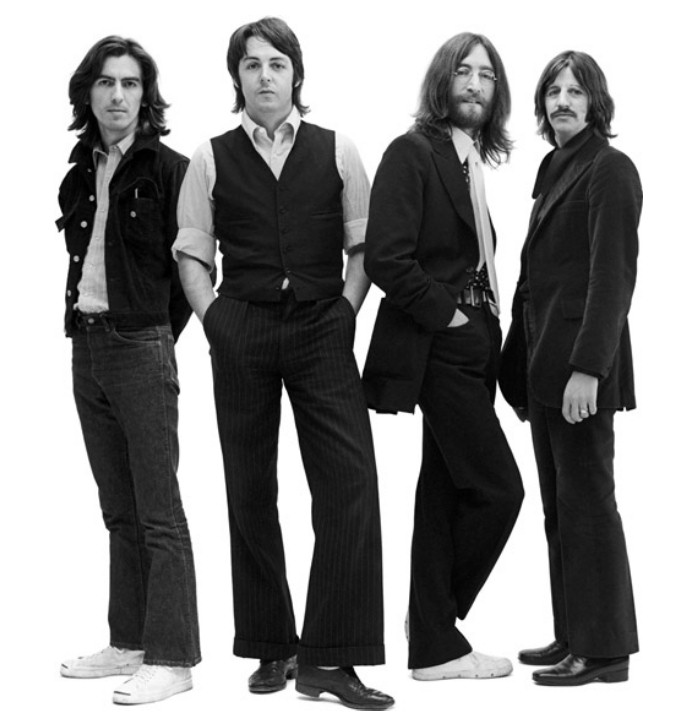
Written in Rishikesh and originally titled Obla Dee Obla Da, the received narrative about this song is that Lennon hated it and furiously forced it over the finish line, propelling the band at breakneck speed with his drug-crazed piano playing.
McCartney was always the musical visionary who could complete what Lennon started but on this song the tables were turned. For once McCartney was at sea musically and it was Lennon that came to the rescue.
A walk through the different versions reveal a clear plan and stunning failure to execute it.
Esher demo
Version 1
Version 2 – this is the version on The White Album
Version 3 – abandoned after a couple of takes and unreleased
All version were played in A but on the Esher demo the guitars are tuned down a semitone to Ab and on version 2 the tape is varisped up a semitone to Bb.
That the song was always intended to be a ska-influenced recording is clear. Calling the song "one of the first examples of white reggae"Stewart Copeland says, "Ob-la-di has an accent, ob-la-da has an accent, 'life goes on...' sort of leads you into that ska feel. There's a definite scansion to those lyrics, which is probably why they ended up playing a ska beat"*. Paul's lyrics and ska-approved vocal percussion "chicka-bum" and Lennon's studio comments "Oobladi-blada. Brutha!", "Yassuh! Take one, and de Mighty Jumbo Band!” show their heads were somewhere more tropical than St. John's Wood, NW8.
Version 1 has been released as an Anniversary Edition bonus track ('Take 3') and on Anthology 3 ('Take 5'). The latter features the (uncredited) creator of the chorus lyrics, Jimmy Scott Emuakpor on congas.
Perfection is attained not when there is nothing more to add, but when there is nothing more to take away.*
Antoine de Saint-Exupéry
The Esher demo and Take 3 feature very straight ahead drumming and strumming – the only hint of ska is the chord fill in the bridge (1:29).
Take 5 (the same take with overdubs) add a lovely tiny cowbell, some busy sax parts, Jimmy's very busy congas and Paul's extremely busy bass.
There is zero groove at this point - no skanking* from guitar or piano and ultra 'white bread' drumming. The bass runs all over the place and the only semblance of a groove comes from congas and cowbell patterns that are messy and confused. The whole thing is a hyperactive hot mess, the result of adding more and more to a track that isn't working. Ringo has no idea what to play and McCartney, uncharacteristically, isn't able to help. Geoff Emerick stated the obvious saying "Paul wasn't happy with the rhythm of the track … he was after a Jamaican reggae feel and he wasn't satisfied that the band had nailed it"* but then went on to tell the tale that has become legend.
When Paul announced he wanted to … start the song again from scratch, John went ballistic. Ranting and raving, he headed out the door, with Yoko trailing closely behind, and we thought that we'd seen the last of him that evening. But a few hours later he stormed back into the studio, clearly in a highly altered state of mind. "I AM F**KING STONED!!" John Lennon bellowed from the top of the stairs … swaying slightly, he continued, waving his arms for emphasis. "I am more stoned than you have ever been. In fact, I am more stoned than you will ever be! … and this," Lennon added with a snarl, "is how the fucking song should go." Unsteadily, he lurched down the stairs and over to the piano and began smashing the keys with all his might, pounding out the famous opening chords that became the song's introduction, played at a breakneck tempo.*
Truth From Fiction
Lennon didn't play the song "at a breakneck tempo". Version 1 was recorded at 121bpm. Version 2 is only 112bpm even after varispeeding up. It was played at 107bpm – significantly slower. Lennon didn't speed the song up, he slowed it down to a tempo that allowed to song to breathe.
Side stepping the fruitless search for 'authenticity' he played what Ian MacDonald describes as a "mock music-hall piano"* intro giving it an instant instrumental hook (Ticket 3), before playing what the song had been crying out for all along the 2, 4 skank pattern. He was incapable of overplaying as McCartney and Emuakpor had been doing and Lennon's limitations as a piano player saved the track. Harrison fell in with a similar rhythm on acoustic guitar and Paul created a new, simple grooving bass line built on arpeggios on 1 2+ 3 4+. And Ringo ? Ringo played the same beat as before. But you can't have everything.
Once the track locked together, other ideas presented themselves. Compare the improvement in the rhythmic accompaniment on "Desmond and Molly Jones" from Version 1 (1:21 – Take 3, 1:23 - Take 5) to the Lennon-driven remake (1:30). There are some childlike plinky piano overdubs (2:32) and a sped-up gliss that sounds like a video game (2:08). McCartney's bassline deserves special mention, using a distorted acoustic guitar (0:02) to doubling the very simple bass line, Paul plays both instruments with a plectrum, adding funky ghost notes on the bass (0:06) that really make the song move.
Mind Blown
It's understandable that Paul would listen to Reggae/Ska and subconsciously absorb melodic ideas. So it forgivable that the start of the bridge has the same melody and almost exactly the rhythm as the opening line of River of Babylon by The Melodians.
In a couple of years
A A D D E F# (landing on a D major chord)
By the rivers of Babylon
D D G G A B B B (landing on a G major chord)
But here's the bombshell. Paul's song was released two years earlier! Did the Beatles have a influence on the seminal 1970 song?*
Footnotes
One of the first examples of white reggae Stewart Copeland: Musician Magazine (1988) perfection is attained Antoine de Saint-Exupéry: Wind, Sand and Stars (p. 31) Paul wasn't happy with the rhythm Geoff Emerick: Here, There and Everywhere (p.246) Skanking Sharp off beat chord hits which are the foundation of reggae & ska (on beats 2 and 4 in reggae and the 'ands' between beats in ska). Paul wanted to start the song again from scratch Geoff Emerick: Here, There and Everywhere (p.247) Mock music-hall piano Ian MacDonald: Revolution In The Head (p.295) Seminal 1970 song It was a no 1 hit in Jamaica on release and reached an international audience via The Harder They Come Soundtrack which is credited with having "brought reggae to the world" (L.A. Times).
For the record I don't think Ob-La-Di is a terrible song – it's a great piece of family friendly lowbrow entertainment written and played with real craftsmanship and made to look deceptively easy. It's like the perfect McDonald's meal. It's probably not good for you as your only diet but I'd like to see you go behind the counter and put one together yourself.
McCartney (with a little help from his friends) displays his gift for doing the very simple and accessible brilliantly. The building blocks are mundane. The structure is V C V C B etc. The chords almost entirely diatonic ('in-key') with only the Bb7 in the bridge (2:16) implied by saxes, venturing 'outside' (Ticket 28). The bridge builds back into the verse with via the V chord (1:31) just like they did in Twist And Shout (Ticket 65). We have a bit of a descant (Ticket 58) coming in at 1:01, the helium effect the obvious result of varispeeding the tape.
Two Melody Tips
One very simple way McCartney generates memorable vocal melodies is through repetition.
In the chorus he repeats the same three notes for
Ob-la-di / ob-la-da / life goes on
Secondly, in the verse he develops a musical cell (Ticket 9), essentially taking a melodic fragment and moving it up one scale tone each time.
Desmond has a barrow in the mar... D D D D D D C Bb A Molly is the singer in a... E E E E E E D C Bb Desmond says to Molly, girl, I... F F F F F F E D
All We Hear Is Radio Bla-Da
A third simple trick he employs is using the 'Aeolian Cadence' (Ticket 10) finishing on the relative minor chord instead of the tonic chord. Here he uses it to delay the ending rather than change it.
Most songs finish with the melody arriving on the root note on the final syllable as the chords land on the tonic chord (in this song a Bb note on a Bb major chord). In the chorus, the melody
D C Bb (Life goes on) happens over an F to Bb chord progression (1:06).
But the final time the same melody occurs over F to Gm (2:57).
This still works, because there's a Bb note in Gm. But that chord (the relative minor or vi chord in the key of Bb) makes us feel like we've been left hanging. Then Paul sings "and if you want some fun..." before the melody walks all the way back down "...sing ob-la-di, bla-da" and Bb note reunites with Bb chord. Hi honey we're home!
Winston And The Trolley Problem
It’s a very me song, in as much as it’s a fantasy about a couple of people who don’t really exist, Desmond and Molly. I’m keen on names too. Desmond is a very Caribbean name. It could have been Winston, that would have been all right.
Paul McCartney*
Paul likes to Write Like A Novelist (Ticket 70) but here the story is a pretty straight forward 'boy meets girl' verse married to a non sequitur chorus
Him: Will you marry me?
Her: Life goes on!
Him: Wait. What? Is that a yes?
Again Paul uses old, familiar tools to build a catchy song.
A ridiculously simple and repetitive rhyme scheme (ABAB) - place/face, band/hand in verse 1, 3 and 4 (reversing hand/band in 3 and 4) and store/door, ring/sing in verse 2. Straight repetition in the two bridges and verse 3 and 4. And parallel lyrics (Ticket 24) to increase the stickiness everywhere.
The bridge has
In a couple of years / with a couple of kids
but the structure of the entire song is built on the lyrical framework of 'Desmond does this, Molly does that' – though Desmond and Molly's positions shift around the verses as aren't always at the same melodic points.
Desmond has a / Molly is a / Desmond says / Molly says this Desmond take a trolley / takes it back to Molly Desmond let's the children / Molly stays at home
This is even more pronounced in the bookending between verses 1 and 3
Has a barrow in the market place / happy ever after in the market place The singer in a band / sings it with the band Molly … I like your face / Molly ... does her pretty face Takes him by the hand / children lend a hand Desmond says to Molly / Molly says this
Very workmanlike but very effective. The only part that stands out is the clever internal rhyme
Desmond takes a trolley / takes it back to Molly
which is surely a result John and Paul's fantastic ear for how words 'sing' than any grand plan. Why else would you take a trolley?
The Beatles had a long history of spoofing lyrics*, constantly messing about for 'laffs'. Paul's first impression of John was to marvel at the way he rewrote lyrics that he didn't know or couldn't remember. So perhaps Paul's "genuine mistake" with the line “Desmond stays at home and does his pretty face” (2:34) was simply playing for laughs as Lennon did with the song in the Abbey Road sessions: "Desmond has a sparrow in his pocket book, Molly had an eagle in the Strand" finishing off with "And if you want some jam!.."
This spoofing is not confined to the lead vocals either. Amid the laughter, genuine (3:06) and fake "ha ha ha" (1:34), there are barely audible asides from John and George all designed to let some air out of Paul's beautiful balloon.
1:42 After the line "lets the children lend a hand" (George: "arm", John: "leg")
2:33 After the line "lets the children lend a hand" (George: "foot")
Though premeditated to some degree, this is still an example of leaving your mistakes in (Ticket 72). Just like counting in, musicians mess around all the time, but most of the mess is cleaned up before the song is offered for public consumption.
Next time: John Lennon the unlikely musical saviour of Paul's granny music.
FOOTNOTES
It’s a very me song Paul McCartney: Many Years From Now (p.348) The Beatles had a long history of spoofing lyrics The frequently altered lyrics live, name-checking local vicars, Bob Wooler and other audience members and changing "shimmy, shimmy" to "shitty shitty" in I Wish I Could Shimmy Like My Sister Kate and "I'm so blue and lonely" to "I'm so bloody lonely" in I Forgot To Remember To Forget. Raining In My Heart became Raining In The Yard and Sharing You - Shaving You. Mark Lewisohn: Tune In (p.128, 419, 429, 539, 606, 680, 821).
Welcome to the post (and song) that threw the spanner in the works of my blogging through the Beatles catalogue. But I'm here to just poke a big stream of consciousness stick down the plug hole of musical constipation ... wait … let me start again …
Revolution and Revolution 1 are unique in the Beatles catalogue. Not merely remixes (Across The Universe), or out of the vault alternative takes (One After 909 on Anthology), or a new piece built on the bones of an existing one (Revolution 9). These are two completely independent attempts on the same song. The Beatles covering the Beatles. Just imagine if Lennon had wanted to release both versions of Strawberry Fields Forever instead of stitching them together?
So before analysing the song it feels apposite to ask: Which is the real version? The right version? The original version? The best version? And is that four ways of asking the same question?
You can attempt to answer via
chronology
personal chronology (i.e. which one you heard first)
personal preference
authorial intent
First, the TL;DR version confirming the world and John Lennon agree with all my prejudices followed by the TL;BIRIAA (Too Long But I Read It All Anyway) version in which I hope to change your mind.
TL;DR - Revolution 1 (aka 'the album version') is the definitive version
Why?
Chronology: It was recorded in Jun 68, a month before the single version.
Personal chronology: I heard the White Album as a kid on my sister's TDK120 cassette – I didn't hear the single till I started Beatles Songwriting Academy in 2009. So there.
Personal preference: That fuzztone is like someone poured itching powder into my eyeballs and it's the most prominent element on the record. Bad tones do have their place on great records (in the background or just prior to something awesome, making it sound even awesomer).
Authorial Intent: Lennon was happy with the album cut and it was only after Paul and George vetoed it as a single that he decided to rerecord it. His comments in 1980 reveal he still considered the album cut to be better.
Convinced? No? Let's dig deeper.
CONFUSING CHRONOLOGY – PERSONAL AND OTHERWISE
Just like Let It Be/Abbey Road, Revolution has a convoluted timeline. Revolution 1 (album version) was recorded first, but released second. The promo video for the single replaced the vocals with a 'live' take (to get around Musician Union rules against miming) and could be considered a third distinct version.
Revolution 1 - recorded 30, 31 May; 4, 21 June
Revolution - recorded 9-12 July
Revolution - released 30 Aug
Revolution Video - recorded 4 Sep
Revolution Video - released 8 Sep (Frost on Saturday)
Revolution 1 - released 22 Nov (UK), 25 Nov (US)
If you were sentient in 1968 you would have heard the 'do-over' almost a full two months before the original. That's a long time to get used to the over-distorted freakout before encountering the laid back jam session. Alan W. Pollack sounds like someone who encountered the single first, calling it “the 'true' version of the song, and the album cut … a remake ... a veritable parody of the single version”.*
First time listeners from 1969 onwards probably heard the album cut first unless they arrived via the 'Blue Album' (The Beatles: 1967–1970) or Past Masters.
FUZZTONE REVISTED
As a rock guitarist I've spent countless hours sampling the nuances of distorted guitar tones like a sommelier of sound. Distortion vs overdrive, pedals vs amp, transistors vs tubes, pre amp or power amp of course humbuckers vs single coils. This single is covered with the stankiest DI'd-to-the-desk “full spectrum of frequencies”* fuzztone, a sound so bad that record buyers were returning their 'defective' singles, only to be met with the explanation “it's called distortion, apparently. It's meant to sound like that”.*
And though George Harrison didn't love the album version, he wasn't impressed with the the single either, “I think Revolution is pretty good and it grooves along, but I don't particularly like the noise that it makes; and I say 'noise' because I didn't like the distorted sound of John's guitar.”*
WAS JOHN HAPPY WITH THE ALBUM VERSION?
Was the album version a demo to be reworked? Did they need two attempts to get it right? Or was the single (recorded second) merely a cover of the album version?
Lennon seems to have been perfectly happy with Revolution. Re-recording it only became an issue when, according to John, “George and Paul ... said it wasn't fast enough”* and vetoed it as a single. Perhaps the guys weren't comfortable with releasing such a overt political statement or “Paul felt that the song simply wasn't all that good”* but fudged the issue.
To be charitable to Paul and the others what they were hearing was not what we hear on The White Album. 'Revolution 1 (take 18)' was a sprawling 10 minutes 29 seconds of hippy flavoured jam. Eventually the second half was lopped off and allowed to carrying on mutating into Revolution 9 like some weird alien limb. It would be understandable if they had mentally consigned such freakishness to the 'album track' bin and were unable to hear it with fresh ears, especially knowing Lennon had no problem with flaunting his experimental underwear in public.
At the same time Paul was pushing for Ob-La-Di, Ob-La-Da to be the single. Neither writer would back down and both set about rerecording their songs to break the deadlock.
“John had defiantly taken [Paul] up on the challenge and so was insisting that they cut it again, faster...that was typical of him in those days; that was his vibe: pissed off”.*
Lennon had a history of needing to speed up his songs. Help and Please Please Me were dirge-like till George Martin got hold of them. Antagonised by Paul, John vented his frustration on the piano, propelling the remake of Ob-La-Di into more ragged, less commercial (and arguably better) territory. On the Revolution single Lennon was taking a similar wrecking ball to his own song but what you are hearing is not the 'soundtrack to a revolution' but two songwriters fighting for an A-side (before Hey Jude came along and rendered the point moot).
“I wanted to put it out as a single, but they said it wasn't good enough...We recorded the song twice. The Beatles were getting real tense with each other. The first take, George and Paul were resentful and said it wasn't fast enough. Now, if you go into the details of what a hit record is and isn't, maybe. But The Beatles could have afforded to put out the slow, understandable version of 'Revolution' as a single, whether it was a gold record or a wooden record”.*
Interviewed 12 years later, John has no problem dismissing other songs he's written as “embarrassing”, “disgusting”, “a horror”, “garbage”, “crap”, “abysmal” and “lousy”* but here it's instructive he says “they said it wasn't good enough”. Undoubtedly the remake has more energy, due to key, tempo and timbre. The bassline moving off the root note more also helps. But the majority of musical changes are arguably cosmetic (see here for a full breakdown).
Unconvinced about the intersection of tempo and commercial appeal, when Lennon describes Revolution 1 as “the slow, understandable version” he wasn't just implying the album cut was better but also that the remake somehow obscured the core message.
It's this point that I want to dig into as it's the reason why the single is less successful and points to an instructive lesson about songwriting.
WHAT'S IT ALL ABOUT, WINSTON?
Authorial intent is key - to assess how well the song 'works' we need to know what the author was trying to achieve, and in Lennon's case, to say.
Written in an ashram in Rishikesh Revolution 1 was a hippie manifesto for peace. The title Revolution occurs ONCE in the entire song. After Lennon opens with “YOU say YOU want a revolution” he spends the rest of the song telling us what HE wants – which is for everyone to chill out and enjoy a little bit of moderate, well-managed change. The chorus (the emotional heart of any well constructed song) is
Don't you know it's gonna be... all right Don't you know it's gonna be... all right Don't you know it's gonna be... all right
It's just the kind of thing you'd expect a man who's been meditating on a mountain, half a world away from riots, invasions and assassinations, a man who “really thought that love would save us all".*
And he reaffirmed this stance at the end of his life, “the lyrics stand today. It's still my feeling about politics. I want to see the plan. That is what I used to say to Abbie Hoffman and Jerry Rubin. Count me out if it is for violence. Don't expect me to be on the barricades unless it is with flowers. As far as overthrowing something in the name of Marxism or Christianity, I want to know what you're going to do after you've knocked it all down. I mean, can't we use some of it? What's the point of bombing Wall Street? If you want to change the system, change the system. It's no good shooting people.”*
Lennon's attitude was unpopular in 1968 and open to the charge that the Beatles were out of touch millionaires. Cocooned in the studio when Bobby Kennedy was shot and Paris rioted, holidaying as Czechoslovakia was invaded, and literally retreating from worldly distractions as Reverend King was assassinated. Harrison expressed the tension in the cut verse to While My Guitar Gently Weeps“I look at the trouble and hate that is raging … as I’m sitting here, doing nothing but ageing”.
But out of touch or not, that is what was Lennon trying to express. So to say “the madman-on-a-street-corner raving of the single resonates more sympathetically with the sense of the lyrics”* or dismiss the album version as a “song about revolution with all the bite taken out”* is wrong.
Revolution is an anti-revolution song.
In the remake the message of the chorus (“Don't you know it's gonna be alright”) is obscured by the missing words and a lack of vocal reinforcement and the only ambiguity in the lyrics - “count me out...in” - is removed.
Pressured by the band to remake the music in “a much more commercial style”* Lennon paradoxically made choices that pleased no one. Masking his peacenik sentiments by punching up the music didn't impress the radical left who labelled the song "a lamentable petty bourgeois cry of fear"* at the same time leaving out the one thing they would have approved of - the ‘count me in’ - “Because I’m a coward – I don’t want to be killed”* by the establishment who continued to view hippy counter culture as a threat anyway.
John didn't like the remake, George didn't like the guitars and Geoff Emerick is probably right saying “I think Paul felt that the song simply wasn't all that good”*. In the 40 years since Paul has never covered Revolution or performed it live.
It's worth noting that when the Beatles recorded the 'video version' (adding live vocals to the single backing track) they undid every change that they could – Lennon adding the “in” back 'in', Paul and George singing “Don't you know it's gonna be” three times and reinstating the almost universally derided “shoo-bee-do-wop" backing vocals.
There is a good song, perhaps a great (if misunderstood) song hidden within two unsuccessful recordings. Perhaps it needed a decent cover version like Marmalade's take on Ob-La-Di, Ob-La-Da*. Something that followed the author's blueprint but had some distance from the distracting circus that the band's life and creative process had become.
Ob-La-Di Ob-La-Da appears in Paul's “Spring Songs: Rishikesh 1968” notebook titled 'Obla Dee Obla Da'. The Esher demo like all other versions is played in A but tuned down a semitone like many of the other demos. Paul harmonises nicely with himself. There's some percussion and someone is shaking a axatse/shekere/calabash.
The coda spends only one bar on the vi chord (3:00) to the finished version's two bars.
The track listing reveals that Version 1 had three saxes, a conga drum (played by Jimmy Scott, the originator of the title phrase) and a piccolo that was wiped almost immediately to make room for an 'acoustic bass doubling the bass line'. I think this is an error I can't hear anything doubling the, frankly erratic, bass line, (listen to 'Take 5' on Anthology 3) and there doesn't seem to be this a double bass or an acoustic bass guitar that the Beatles used or had lying around (see Beatles Gear). I think this 'doubling' comment refers to Version 2 and the piccolo was wiped for McCartney's only bass overdub.
Take 3 of version 1 appears as an 'outtake'. McCartney's 'chick-a-boom' asides, 'one bar' coda and self harmonising from the Esher demo are all still present. Take 5 (the Anthology 3 track) is the same take with overdubs - some busy sax parts, Jimmy's very busy congas and Paul's extremely busy bass. Version 1 also seems to speed up half way through. But the tiny cowbell overdub is cool.
Version 2 also has three saxes but no Jimmy.
Here's a theory: Was one reason for recording a second version that McCartney uncomfortable with having Jimmy Scott on the track? Unable to remove him as saxes and percussion were all recorded on the same track, Ringo later added another conga overdub anyway. Was Paul worried Jimmy's claim to authorship would be strengthened if he actually appearing on the disputed track? Or was it just his busy conga playing?
This time we have a distorted acoustic guitar doubling the very much simplified bass line.
Version 3 was attempted (with Paul on drums) but abandoned after a couple of takes and the band returned to finish version 2 which was recorded in A and tape sped up to Bb (noticeably affecting the backing vocals at 1:09).
The line “Desmond stays at home and does his pretty face” (2:34) was a genuine mistake which Paul liked and decided to keep.
Join the mailing list to get the free, exclusive, Beatles Songwriting Academy podcast!
Cry Baby Cry occupies a unique position in the Beatles catalogue. There are many songs where Lennon and McCartney both claim to have contributed the majority of a song, but here we have a song that neither Lennon nor McCartney wanted any credit for. The acrimonious atmosphere it was recorded in caused long time engineer Geoff Emerick to quit, telling George Martin "I want to leave now, this very minute." Yet the band seemed to work conscientiously on it, knocking it out in a couple of days.
Cry Baby Cry was another of John's songs from India … Because John had divorced Cynthia and gone off with Yoko, It meant that I'd hear some of the songs for the first time when he came to the studio, whereas in the past we checked them with each other.
Paul: Many Years From Now (p.487)
Paul gives John sole credit, denying involvement or even prior knowledge! But when asked by Playboy for his thought on the song Lennon simply replied
Not me. A piece of rubbish
John: All We Are Saying (p.200)
Paul's statement is self contradictory. If it was a Rishikesh song then Paul must have heard it. And he certainly heard it again when they gathered to demo songs at George's house Kinfauns. Why was he so keen to distance himself from this one when he admitted he liked it?
And why did John, the Beatle most likely to get bored and lose focus, put so much work into “a piece of rubbish”, reaching McCartney levels of multi tracking, playing acoustic guitar and then overdubbing organ, piano and lead and backing vocals?
A day rehearsing and a day plus change recording is reasonable going for late-era Beatles. It's doesn't seem like the kind of work-rate that would leave lots of time for bitter feuds. And nailing the basic track in ten takes doesn't seem like the kind of problem piece that would cause bad feeling. It's a far cry from scrapping and rerecording the entire thing as they did with other songs on this album. So what made Geoff quit on this of all days?
Untangling The Mystery
Sometimes when a relationship breaks down, the 'straw that breaks the camels back' is something innocuous. A casual observer might be nonplussed as to what the problem is. It's only when you dig around that you understand.
What preceded the unfairly maligned Cry Baby Cry? Ob-La-Di Ob-La-Da and Revolution.
The song that Paul was pushing to be the next single vs the song John was pushing to be the next single. Or if you prefer, the song that John (and George) "openly and vocally detested" vs the song that Paul and George thought was too politically 'on the nose' to be the next single. Or the song that Paul had made his bandmate slog through three recorded versions vs the song Paul and George had (rather unwittingly) goaded John into completely rerecording.
The Beatles 'every member has a veto' policy had them deadlocked. Where they used to earmark a song as a single before it had even been written now they were at a standstill. In fact, worse than a standstill, they were forcing themselves to go back and rerecord songs like some kind of tie-breaker. In the end neither John nor Paul got what they wanted. Paul gave up on Ob-La-Di* and offered Hey Jude in it's place and Revolution was relegated to the B side.
So it's my hunch that the bad feeling at the session and the eagerness to disassociate themselves with Cry Baby Cry was actually based on all the crap that has gone on before.
Does this have anything to say to us lesser mortals trying to write better songs?
Recovering From A Difficult Birth
Songwriters and recording artists can find it impossible to be objective about their own work. For an artist, the song is almost inseparable from the circumstances of it's creation. John said “I can't stand hearing them all the time! Because I have to relive the sessions. It's not like I hate Beatles music. It's like reading an old diary [or going] through your old snapshots”**
A song that flowed out in a single sitting or a track that was a first take is always going to have a warm glow about it. Compare that to a song that was slaved over, rewritten, rerecorded, remixed endlessly. I experienced this with my song I Got Lost. When I heard positive comments from first time listeners I was surprised. I had regarded the song as difficult and inaccessible. Why? I struggled to get the vocal track down, recording it over three separate sessions. The dread of revisiting the vocal booth had coloured my perception of the song.
When the audience hears our song they only hear the song. But a songwriter can hear 'two' songs. The song as they originally conceived of it and the reality. The intention verse the execution. This is an insidious pastime to indulge in because the imaginary song is often perfect whereas the reality can fall drastically short.
So once you have created your song, open it out to the world. During the creation process yours is the only opinion that truly matters so 'keep the door shut'. But once you've finished, or more accurately, 'released' your song your opinion of it is only one among many and no more valid than anyone else's. Listen to others and be willing to be wrong.
Cry Baby Cry isn't deep and meaningful, but it is a great song. It's the result of simply Lennon's imagination taking a stroll in the Wonderland of his youth. It's a well crafted in performance arrangement and composition. That's what I'd tell John and Paul.
After weeks of promises I'm happy to say I've completed the remaining research for the Let It Be and posts should start rolling on Monday. Thanks for your patience!
My parents had a pretty good record collection, and they used to give me albums to listen to on my little record player. I got [The White Album] from them in about fourth grade, and I played it until I wore through the grooves. It's so universal, and as I get older and come back to it, it's better than ever. Over the years my favourite song changes, however. In those days I liked Rocky Raccoon and Ob La Di, Ob La Da. Now I really like Long, Long, Long,...Who knows what my favourite will be next year?
The tragedy is not that Maxwell is a poor song but that McCartney “flogged it to death in the studio in a pedantic effort to perfect it [and] ended up driving his colleagues mad” acting like an “immature egotist who frittered away the group's patience and solidarity on sniggering nonsense” (MacDonald p.357) just like he did to an even greater extent with Ob La Di, Ob La Da
The funny thing is that everything McCartney did wrong on this song he's done with wonderful success on other songs.
Written at the tail end of the White Album, rehearsed during the Let It Be sessions, recorded over 3 days in July 69 with more overdubs and tweaking in Aug this was a major piece of work (the band even rented an anvil for Ringo to play) that totally failed to live up to (Paul's) expectations. Here are three questions that you can ask to stop yourself making the same mistakes. 1) Are my fellow musicians up for this song? 2) Is there a legitimate technical reason why this song is taking so long? 3) Does this song warrant the amount of polish I'm lavishing on it?
A splendid time is guaranteed for all
Q: Are my fellow musicians up for this song? If not keep it short or save it for the solo album.
Yellow Submarine was just as silly as Maxwell, if not more so. It took two days to record. But by all accounts the band had a whale of a time (you see what I did there?). Playing bathtubs, blowing bubbles shouting nonsense through echo chambers, marching round with a bass drum in a conga line with Brian Jones & Marianne Faithful. What's not to like? Lennon & Harrison despised Maxwell and Lennon took no real part in the recording.
Long Long Long
Q: Is there a legitimate technical reason why this song is taking so long? If not get the best version you can quickly and then call it a day. You can always revisit it some time in (distant) the future. A Day In The Life took 5 days to record over a period of 2 months. You Know My Name (Look Up The Number) took 4 days over 3 years. Some thing take longer because they're complex and you're breaking new ground, and some take longer because you're desperately trying to make something brown and smelly look bright and shiny. Ob La Di, Ob La Da and Strawberry Fields Forever were both recorded, scrapped and rerecorded. Guess which one the whole band were most enthusiastic about...
Hey! You've got to throw that song a-way
Q: Does this song warrant the amount of polish I'm lavishing on it? If not recorded it roughly and move on.
Throw away songs are great and you don't have to throw them in the bin. Just throw them on the table like the musical junk food they are. You don't need to get the silverware out. What if Maxwell had been a solo acoustic number played in the same loose style as Her Majesty? Or a raucous jam like Maggie Mae? Wouldn't that have been better? It certainly would have engendered more goodwill with it's take it or leave it attitude than the version we have.
This is something I find myself facing when recording joke songs like The Soundcheck Song so I hope it's helpful to you. Do you have any other suggestions for knowing when you're giving too much time to an inferior song?
I may post better tributes to the Beatles but I'll probably never post one from a younger player than the legendary 5 year old Japanese Ukeleleist (Ukeleler?) Uke3453. Enjoy!