Showing posts with label Lyrics. Show all posts

Thursday, 18 April 2019

White Album 50th Anniversary Notes (pt.2) - Later Lyrics

More Lyric Facsimiles (Probably Post Rishikesh)


Performance Notes

Several of John's songs have some kind of vocal performance direction above the title.

I'm So Tired - “Smokey then heavy voice” a reference to Smokey Robinson?

Revolution - “Marha [?] - Diana - light voice” perhaps another Motown reference - Martha Reeves and Diana Ross?

Bungalow Bill “Band (Water Melon). children!” possibly a (faintly racist?) reference to the band singing backing vocals?


Lyrical Evolution


I'm So Tired

Verse 2, line 2: my mind is set on you is missing.
Verse 3, line 2: Although I'm so tired > Although I'm choked – Lennon obviously later went back to his first choice.
Verse 3, line 3: I believe Sir Walter Raleigh he was > And curse Sir Walter Raleigh he was

When I wrote about this song I was unsure whether to call the “You'd say I'm putting you on” section a chorus or a bridge but it's labelled “8” so in Lennon's mind it was a middle eight – a bridge.


Don't Pass Me By

Penned in purple felt-tip are (unused) lines that Hunter Davis calls “funny in their awfulness” dubbing Ringo “a modern day William McGonagall”

I feel a little foolish sitting here alone
Instead of eating crackers I think I'll just get stoned

You came all wrapped in cellophane
With purple bursting free
The card said open carefully
And pay for C.OD [sic]


Yer Blues

My Mother was of the earth > My Mother was of the sky
My Father was of the sky > My Father was of the earth
But I am of the underworld > But I am of the universe

I'm feeling so uptight now just Dylan's Mr Jones > I feel so suicidal just Dylan's Mr Jones


Back In The USSR

The final verse is added. The last line is initially missing then added as

Let me hear your balalaika working out > Let me see your balalaika working out

Recorded as Let me hear your balalaika ringing out


While My Guitar Gently Weeps


Written on 'NEMS London' headed paper While My Guitar Gently Weeps begins with a list of rhymes

Tampering – tapering, Tempering – thundering,
Tittering – Tottering, Towering, Toppling [TICK]
Wandering - Watering, Wavering, Weathering
Whimpering, wintering, whispering, Wondering [TICK]

and later on the manuscript

Burning
churning
learning
yearning

adding further supporting evidence that Harrison was suffering from a bad case of rhyme's disease when he penned this otherwise excellent song. The manuscript gives a window into the lyrical development. Verse 1 is fully formed but verse 2 develops from

I look at the sky and I notice it's clouding

which is then replaced by

I look at the world and I notice it's turning
While my guitar gently weeps
I'm wondering why your nigars[?*] keep on burning
still your guitar gently weeps! > still my guitar gently weeps!

[*Everett has it as 'cigars' but it certainly doesn't look like a 'c'!]
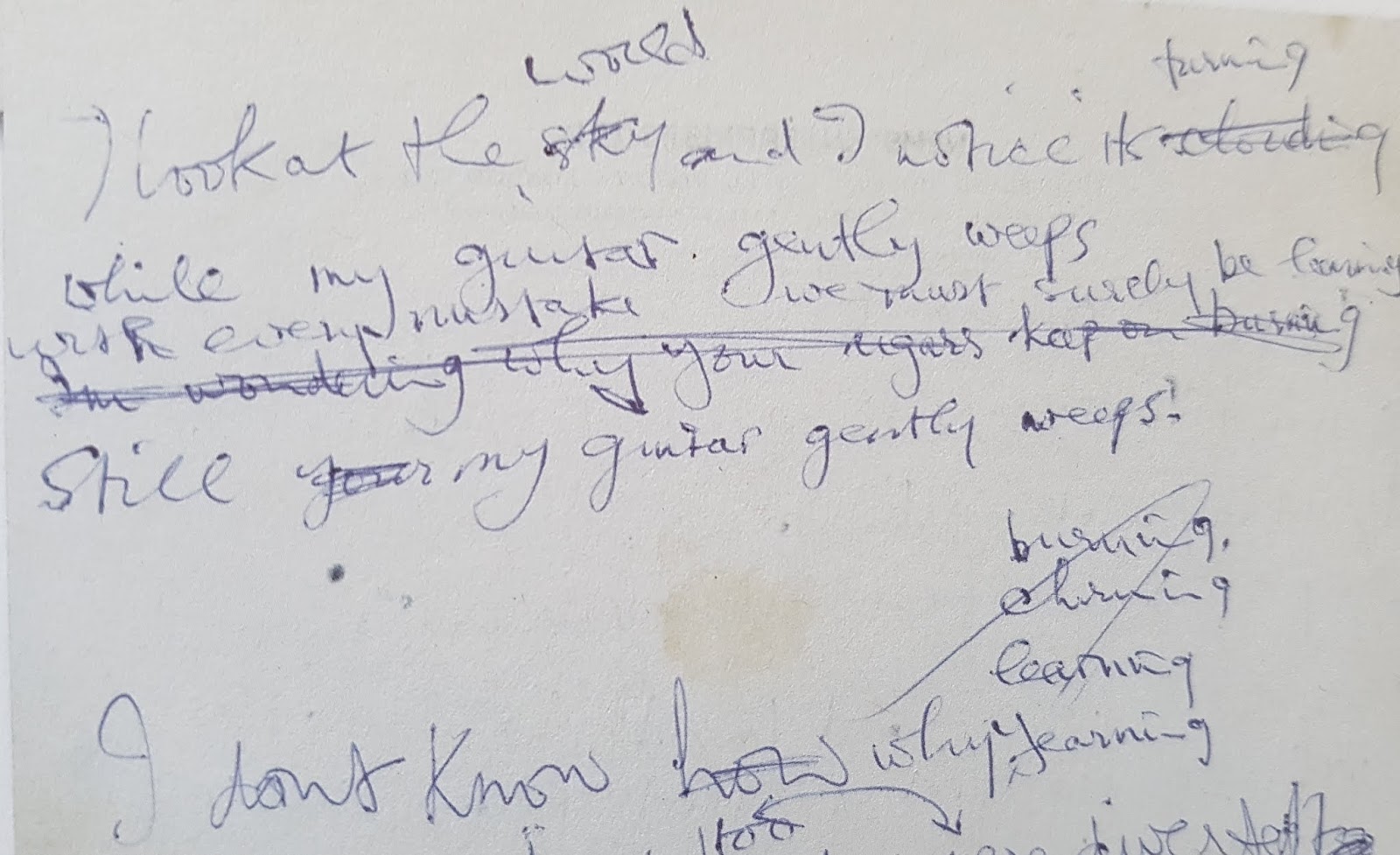

After the Burning/churning/learning/yearning list the lyric takes it's final form as

I look at the world and I notice it's turning
While my guitar gently weeps
With every mistake we must surely be learning
Still my guitar gently weeps!

I don't know how, someone controlled you, how they
blindfolded you.

Then the bridge undergoes a minor change

I don't know how
You were perverted – you were diverted too
I don't know why you got inverted
No one alerted you

as 'why' and 'how' change places

I don't know why
You were perverted – you were diverted too
I don't know how you got inverted
No one alerted you

George makes a number of attempts to start verse 3

I look at the powers around

I look at the wars of the world that are raging

I'm thinking of wars everywhere that is raging

I look at the trouble and hate that is raging

none of which he seems as happy with as verse 3 line 3

While I'm sitting here doing nothing but ageing

which is tweaked to

As I'm sitting here doing nothing but ageing

This verse survived to the Esher demo

I look at the trouble and pain that is raging
While my guitar gently weeps
As I'm sitting here doing nothing but ageing
Still my guitar gently weeps

by the time they got to Abbey Road (the 'Version 1' acoustic guitar/harmonium 'demo' that appears on Anthology 3 and 'Love') it's become

I look from the wings at the play you are staging
While my guitar gently weeps
As I'm sitting here, doing nothing but ageing
Still my guitar gently weeps

By the final version it's been replaced by a restatement of the first verse

I look at you all see the love there that's sleeping
While my guitar gently weeps
Look at you all
Still my guitar gently weeps


Birthday

After the section marked “SOLO” [1:28] is one called “STAGGERS” – the guitar/bass solo break [1:48]

Helter Skelter


An embryonic version of the 'jazz-style intro verse' is written after the 'do you don't you' verse supporting my theory that the intro was originally the chorus and the chorus was originally the bridge (or 'middle' as Paul notates it)

I go back to the top of the hill (ride)
And I stop and I turn and I give you a thrill
Till I see you again


Piggies

This is a post Esher version (in pencil) as it containing Lennon's line "Clutching forks and knives to eat their bacon" (Harrison had sung "Clutching forks and knives to cut their pork chops" on the demo). Mrs. Harrison's line "what they need's a damn good whacking!" is overwritten in red pen for emphasis!

There is also a cut 4th verse that George reinstated on the 1992 Live In Japan album.

Everywhere there's lots of piggies
Playing piggy pranks
You can see them on their trotters
At the piggy banks
Paying piggy thanks
To THEE pig Brother


Revolution

contains a Harrison-style list of rhymes

constitution
institution
desolation
revelation
pollution
dissolution
confusion
intrusion
distribution [?]
Constitution [?]


Glass Onion

Written on the back of an envelope, Glass Onion omits the word 'man' from the Walrus and me/close as can be lines and reveals that Lennon was even more ambitious about trying to cram in self-references

Trying to make a dovetail joint for a yellow submarine


The Continuing Story of Bungalow Bill

is titled '(the continuing story of) BUNGALOW BILL'


Hey Jude

She has found you now go and get her > You have found her now go and get her

The final version was only settled on very late in the recording sessions


Next: Recording Notes


Join the mailing list to get the free, exclusive, Beatles Songwriting Academy podcast!

Tuesday, 18 July 2017

Five Unusual Songwriting Tricks from The Beatles


[Originally published on Sharon Goldman's Songwriting Scene blog 17 Nov 2010].

The Beatles were songwriting Ninjas, but they employed many tricks that anyone can add to their songwriting tool box. Here are five less obvious examples:

1. Mutate Your Chorus

As well as starting songs with the chorus, some of The Beatles greatest hits open with a chorus hybrid that previews the title and hooks.

The intro to Help has the same chord progression as the chorus but moves twice as fast and features the title 4 times (to the chorus's 3). Use this trick and by the time you reach your chorus the listener will be hooked by the reassuring feeling that they've heard your song somewhere before.

Also used on: She Loves You, Can't Buy Me Love. 

[Read more]

2. Bluesify Your Melody

We expect to hear blue notes like the b3rd, b5th and b7th in rockers like Back In The USSR but the Beatles often added these notes into more melodic material too.

In Blackbird the final phrase uses the b7th on inTO the LIGHT and the b3rd on dark BLACK night. This trick will add a soulful edge to your melodies but it's hard to pull off unless you're a confident singer. Inserting the blue note into your chord until you've can pitch it correctly is a smart move.

Also used on: Ticket To Ride, From Me To You.

[Read more]

3. Delay The Root Chord

Starting a song on the tonic chord is a rut the Beatles managed to avoid a surprising number of times.

Eleanor Rigby starts on C major (the bVI of Em) before heading to the home chord. It's one of the things that gives the track such a sense of tension. Using this trick will give your progressions more forward momentum.

Also used on: All My Loving, Hello Goodbye.

[Read more]

4. Utilise The Outside Chord

Many of us employ out of key chords (whether we realise it or not!). But out of 186 original Beatles compositions only 16 stay in key!

In Strawberry Fields Forever, Lennon pulls the rug from under the Bb major tonality by replacing the F major chord with an F minor.

Bb Let me take you down cos I'm going Fm to

Its like the stomach drop you experience on the crest of a rollercoaster. Later he creates a disorientating momentary high by replacing the Gm with a G major.

Eb Nothing to get G hung about

Outside chords will surprise your listeners and freshen your melodies.

Also used on: I Am The Walrus, Fool On The Hill. 

[Read more]

5. Restate Your Lyrics

The Beatles didn't make their lyrics memorable just by repeating sections wholesale. They also repeated and adapted words, phrases and sentence structures.

Take A Day In The Life. 4 verses, a middle 8 and only one repeated line. And yet it's memorable (in part) because of lyrical links like these -

I - read the news/saw a film - today, oh boy
and though the - news was/holes were - rather - sad/small
found my - way downstairs/coat/way upstairs
I just had to - laugh/look

Using this subtle trick will make your lyrics sticky and give a sense of unity to a track.

Also used on: Fixing A Hole, The Long And Winding Road. 

[Read more]

Like these? Here's 70 more Songwriting Tips From The Beatles!

Join the mailing list to get the free, exclusive, Beatles Songwriting Academy podcast!


Friday, 30 June 2017

10:58 Cry Baby Cry (pt.2) - Nursery Rhymes


Lennon dismissed Cry Baby Cry as "a piece of rubbish" not only due to the traumatic circumstances it was recorded in but also in he had a tenancy to get bored with anything he'd worked on in the past and grew, under the influence of Yoko and various therapies, to despise anything that wasn't 'real' and autobiographical. This made a meaningless, fictional flight of fancy like Cry Baby Cry an obvious target for the the later Lennon to take a shot at.

Though there's a dreamlike sense of Lewis Carroll hovering over the song, the initial inspiration for the hook came from an advertisement (as did Mr Kite and Good Morning Good Morning)* But the most obvious influence is a nursery rhyme

Sing a song of sixpence a pocket full of rye
Four and twenty blackbirds baked in a pie
When the pie was opened the birds began to sing
Oh wasn't that a dainty dish to set before the king? 
The king was in his counting house counting out his money
The queen was in the parlour eating bread and honey
The maid was in the garden hanging out the clothes
When down came a blackbird and pecked off her nose

It's interesting to see Lennon return to the same source again in 1980. Clean Up Time has the stanza

The Queen is in the counting house
Counting out the money
The King is in the kitchen
Making bread and honey

Here Lennon is infusing old imagery with new meaning. During the 70s Yoko took over the business affairs and John became a house husband. This clever repurposing allows John to be 'real', autobiographical and use borrowed sources all at the same time by changing only a few words.

However that doesn't take away from Cry Baby Cry. It's still a brilliantly constructed fantasy song. The sustained fairy tale imagery and portrait of mundane domesticity is built on the Beatles (and nursery rhyme's) use of parallel lyrics (Ticket 24). Consider the recurring pattern of 'character - location – activity' in the verses**

characters

The King/Queen/Duke/Duchess/Children(and the nursery rhyme's Maid)

location

was in the kitchen/parlour/garden/playroom

activity

cooking breakfast/playing piano/picking flowers/painting pictures (note all these phrases have four syllables)

Another interesting structural technique is bookending the lyrics on the chorus which Lennon also did in Sexy Sadie

Cry baby cry
Make your mother sigh
She's old enough to know better
So cry baby cry

Sexy Sadie what have you done?
You made a fool of everyone
Sexy Sadie, oh, what have you done?

The origin of the Duchess causes a lot of confusion online. She's from Kirkcaldy, a town on the east coast of Scotland, 11 miles north of Edinburgh.

But as for what The Bird And Bee is, it's unclear. Many say it's a plausible name for a Pub, but the fact that the Duke is 'having trouble with a message' always conjured up the image of him preparing a talk for a group like the Women's Institute.

But what do I know? And did Lennon know? Probably not. Perhaps that very McCartney style vagueness was another reason Lennon disowned this tune.

Next time we'll finish with a look at the music and arrangement.


*The proverbial phrase “old enough to know better” dates back at least to Oscar Wilde in Lady Windermere's Fan (1892) “My experience is that as soon as people are old enough to know better, they don't know anything at all”.

**Another parallel is the meals – breakfast/tea (The king cooking breakfast / the duchess arriving for tea)

More White Album Posts

Join the mailing list to get the free, exclusive, Beatles Songwriting Academy podcast!

Tuesday, 3 November 2015

Ticket 73: Break The Rhyme Scheme


Don't Be Afraid To Break Rhyme

Lou Reed

(U2 by U2 p.196)

Rhyme creates a pleasing sense of structure and breaking it can really annoy your listeners and mark you out as an amateur BUT interrupting the rhyme scheme for a good reason can make you look like a master. Three good ways to break a rhyme are

  • Look back - by rhyming your line with one in the same place in a previous verse.
  • Look forward - by rhyming with an extra line still to come.
  • Mess with expectations - by 'telegraphing' an obvious rhyme and them substituting the synonym or other unexpected word for humorous effect.

McCartney 'breaks' the rhyme scheme in Hey Jude's second bridge without making it feel wrong or awkward. Because the 'broken' bridge

in/begin/perform with – you/do/shoulder

calls back to the first bridge

pain/refrain/shoulders – fool/cool/colder

In Octopus's Garden Ringo ends every verse with a simple rhyme

I'd ask my friends to come and see
An octopus's garden with me


We would sing and dance around
Because we know we can't be found


But on the 3rd verse he alters the pattern

We would be so happy you and me
No one there to tell us what to do


which sets up the new coda section

We would be so happy you and me
No one there to tell us what to do
I'd like to be under the sea
In an octopus's garden with you


The comic power of a 'mind' rhyme comes from using the listeners' expectations against them. Setting up a rhyme with an expletive or some other embarrassing word, then dodging it at the last moment can be very effective.

I have a sad story to tell you
It may hurt your feelings a bit
Last night when I walked into my bathroom
I stepped in a big pile of shaving cream

Shaving Cream (Benny Bell with Paul Wynn)

1968 Hey Jude - The Beatles
1968 I Will - The Beatles
1969 I’ve Got A Feeling - The Beatles
1969 The Long And Winding Road - The Beatles
1969 Octopus's Garden - The Beatles

Also

1932 Eadie Was a Lady - Ethel Merman
1933 Sitting On The Ice In The Ice Rink - George Formby
1937 I Can't Be Bothered Now - Fred Astaire
1946 Shaving Cream - Benny Bell with Paul Wynn
1959 The Real American Folk Song (Is A Rag) - Ella Fitzgerald
1971 L'America - The Doors - "Change the weather, change your luck / And then he'll teach you how to ...... find yourself"
1988 Kiss Me Son of God - They Might Be Giants - “Now you're the only one here who can tell me if it's true / That you love me... and I love me”
1989 On the Greener Side - Michelle Shocked - "You say you want to give me a run for my money / There's something I'm gonna admit / Well, it may sound funny, but Romeo, honey / I don't want none of your … love"
1991 Under The Sea (The Little Mermaid) - Samuel E. Wright – coda
1992 One More Sleep Till Christmas (Muppet Christmas Carol) - Steve Whitmire
2003 Mr Brightside - The Killers - comedy mind rhyme (0:33)
2013 In Summer [From Frozen] - Josh Gad - “Winter’s a good time to stay in and cuddle / but put me in summer and I’ll be a...happy snowman!"


See also

Ticket 23: Write fewer lyrics
Ticket 24: Repeat words and sentence structures
Ticket 54: Unify your lyrical imagery
Ticket 72: Embrace your mistakes

See the full list of songwriting tips here - Tickets To Write

Join the mailing list right here!

Links

Friday, 2 October 2015

Hey Jude Bonus Post (What Does The Vox Say?)


Here's the internet's best guess at the Hey Jude fade out lyrics. You're welcome.

Ju-Judy Judy Judy Judy Judy
OW, WAHOW! 

Ow hoo, na na na 

JUDE Jude JUDE Jude Joooo... 

Na na na na na, yeah yeah yeah 

Yeah you know you can make it, yeah
Jude, you not gotta break it 

Don't make it bad Jude 

Take a sad song and make it better 

Oh Jude, Jude
Hey Jude
WHAAAAOOOOW 

Ooo, Juuuude 

Yeah 

Hey, hey, hey, hey, hey-ee-yay-yay-yay 

Hey, hey, hey 

Now Jude Jude Jude Jude Jude Jude
Yeah yeah yeah yeah 

Woh yeah yeah 

Ah nanananananana cause I wanna 

Nanananana ... nanalala ow ow ow 

Oh God 

The pain won't come back Jude 

Yeah, eh hehe heh 

Make it Jude 

YEAHYEAHYEAH YEAH! 
YEAH! YEAH! HA HA HA HA HA.... 
 
Goodeveningladiesandgentlemen
Mymymymy my my mahhhh 
 oooo 

Woooh 

A-well a naaaa-nanan (fade)

More useful posts on the Hey Jude lyrics here and here.

GET EXCLUSIVE CONTENT BY JOINING THE BEATLES SONGWRITING ACADEMY MAILING LIST right here!

Tuesday, 29 September 2015

10:49 Hey Jude (pt.3) Rhyme Scheme Slight Return - Nicholas Tozier Guest Post


There are many excellent websites and books around but I'm fortunate to have a few real live people I can call on for advice when I hit a bump in the road as well. I'm honoured to have Nicholas Tozier from Song Written as a blogging buddy and one of my 'Beatles Brain Trust'. He's made stellar contributions to BSA in the past (here and here) and his reply to my questions about Hey Jude's rhyme scheme was so interesting I got his permission to post it here.

Hey Matt

I’d never looked at Hey Jude on the page, but you’re right; looking down the line ends is less than half the story with this rhyme scheme. There are lots of surprises in this one.

I think the simplest way to explain it is:

End-rhyme is the default in most lyrics, but verse one of Hey Jude uses chain rhyme and internal rhyme – meaning the rhymes resolve and turn around more quickly. It’s analogous to when a melody touches on the tonic for a sense of resolution, then immediately moves off the tonic.

What’s actually happening is a little more nuanced than that, but that’s most of the story.

I don’t think a linear list of rhymes does justice to this verse.

Hey Jude, don't make it bad
Take a sad song and make it better
Remember, to let her under your skin
Then you'll begin to make it better

Let’s reduce it to a wireframe of syllables (x), with rhyme and refrain positions labeled:

x x x x x A
x x A x x x x BR
x B x x B x x x x C
x x x x C x x BR

Whatever’s going on here, we sure can’t call it end rhyme. The rhymes tend to open at the end of one line, then resolve at the beginning of the next line. Lines one, two, and the beginning of three are straight-up chain rhyme.

Then, in the middle of line three Paul adds a plot twist with another internal “B” rhyme, surprising our ears. This sets the new rhyme-point as the middle of the line. “C” sets up as expected at the end of line three, and then “C” resolves toward the middle of the verse’s last line, like line three did.

Still, I think the best way to get a feel for the truth of Verse One’s sonic mysteries is just staring at the diagram.

Thanks again for sharing this. I had a blast trying to deconstruct it.

—Tozier

P.S. Kinda intriguing that the refrain “make it better” has a different melody each time, so we actually don’t hear it as an obvious refrain so much. Its repetition is downplayed by the melody. That might be significant to the verse’s overall lyrical feel, because the refrain is the only end rhyme, and since the melody changes, the end of the quatrain sounds less resolved, more unsettled, building our anticipation for the next section.

Song Written is one of the best songwriting sites out there. Check it out.

Related Posts


Links

SIGN UP! Join the BSA mailing list for free and exclusive content right here!

Monday, 21 September 2015

10:48 Hey Jude (pt.2) Lyrics - How Do You Solve A Problem Like McCartney?


I'll be honest folks. When I started work on Hey Jude I was tempted to induct it into the Lyrical Hall Of Shame. The combination of dummy lyrics that never got replaced, words chosen for the way they sound, and 'it-means-whatever-you-want-it-to-mean-man' attitude adds up to a lame lyric riding the coattails of a world class melody. And that's before you realise that half the song consists of the word 'nah' sung 209 times.

But digging deeper I've realised the lyrics display such structural genius that I'm more than willing to give Paul a pass on this one. But let's look at the negatives first.


Star Wars For Dummies

As was often the case, McCartney had the music locked by the time the recording started but the lyrics were still in flux (like Rocky Racoon and I Will). If you listen to the Anthology 3 rehearsal Paul doesn't have them all (or he doesn't know them). He indulged in a Yodaism in the phrase “for well you know that it's a fool” and the song contains placeholders lines, as Paul admitted

I remember I played it to John and Yoko, and I was saying, 'These words ['The movement you need is on your shoulder,'] won't be on the finished version'... and John was saying, 'It's great!' I'm saying, 'It's crazy, it doesn't make any sense at all.' He's saying, 'Sure it does, it's great.'" *


Creepy Words Of Wisdom

Secondly, the song had an odd genesis, which goes some way to explaining the bizarre interpretations that have followed.
It was optimistic, a hopeful message for Julian: 'Come on, man, your parents got divorced. I know you're not happy, but you'll be OK.' I eventually changed 'Jools' to 'Jude'**

Changing Jools to Jude cos it 'sings' better is all well and good. But this is a song written to comfort a 5 year old boy about his parents divorce, yet it seems to consist of philosophical advice on getting a girlfriend - a flower-powered take on the 'love life advice' sub-genre that dates back to She Loves You.


There were clearly other biographical currents bubbling up into the song. Paul was in the no(wo)mansland between Jane Asher and Linda Eastman. John heard it as an endorsement for his relationship with Yoko, a thumbs up from Macca's subconscious. Both Beatles were caught between their commitment to making art with multiple (even unintended) meanings and their contempt for the public reading their own meanings into Beatles lyrics. John in particular felt embarrassed at doing exactly what he condemned in others

He said it was written about Julian … But I always heard it as a song to me. Now I'm sounding like one of those fans reading things into it... Think about it: Yoko had just come into the picture. He is saying. 'Hey, Jude'-- 'Hey, John.' Subconsciously, he was saying, 'Go ahead, leave me.' On a conscious level, he didn't want me to go ahead. The angel in him was saying, 'Bless you.' The devil in him didn't like it at all, because he didn't want to lose his partner***

The debate over open interpretation was thrown into sharp focus once Charles Manson got his hands on a copy of the White Album, read murderous things into the lyrics of Helter Skelter and Piggies, and put his crazy interpretations into action.

Advice on preschool love and loss? The Pre-Ballad Of John And Yoko? Or a Dear Jane letter, containing a deep and meaningless line about a parrot?**** No wonder Manson et al had a field day.

Lennon for what it's worth never changed his assessment, calling Hey Jude

“[Paul's] best song" and “a damn good set of lyrics” *****

So what do I know? Let's look at the good stuff.


A fine line between stupid and clever

For starters verse 4 is a mutated hybrid of verse 1 and 2. This makes it feel familiar but not totally predictable. As usual the song is full of parallel words and phrases (Ticket 24)

make it bad/better/you were made

let her into your heart/under your skin

let it out/in

don't make it bad/be afraid/let me down

remember to/the minute you let her into your heart

plays it cool/a little colder

carry the world upon your shoulders/movement you need is on your shoulder


Also McCartney manages to 'break' the rhyme scheme in the second bridge without making it feel wrong or awkward.

In the first bridge the rhyme scheme is

AAB - CCB (pain/refrain/shoulders – fool/cool/colder)

but the second bridge is

AAB – CCD (in/begin/perform with – you/do/shoulder).

Feels really jarring when you focus solely on the last words doesn't it? (Another case for not keeping a meaningless dummy lyric) but in the song it sounds fine. (Be honest. Have you ever noticed it before?). McCartney's masterstroke is that he breaks the rhyme using a word that rhymes with the first bridge, so it feels right even though it's totally 'wrong'.

We've encountered this technique before in The Long And Winding Road (and Ringo break a rhyme for a different reason in Octopus's Garden) so it's high time it got it's own ticket. Welcome Ticket 73.


But the crowning achievement is the way Paul uses internal rhymes to create a kind of odd-meter, seven line stanza that transforms the verse from this

Hey Jude, don't make it bad
Take a sad song and make it better
Remember, to let her under your skin
Then you'll begin to make it better

into this

A7 - Hey Jude, don't make it bad
A3 - Take a sad

B6 - song and make it better
B6 - Remember to let her

C4 - into your heart
C4 - Then you can start

B5 - to make it better

More amazingly he maintains this punishing rhyme scheme perfectly through the three remaining verses

Hey Jude, don't be afraid
You were made
to go out and get her
The minute you let her
under your skin
Then you begin
to make it better

Hey Jude, don't let me down
You have found
her, now go and get her
Remember to let her
into your heart
Then you can start
to make it better

And there's a few other internal rhymes scattered around. The first verse contains a bonus rhyme

Hey Jude, don't make
it bad, Take
a sad song...

Beautiful. And we're not done yet. There's a few more things to say about lyrics...

Footnotes

* Paul 1974  Beatles Songwriting And Recording Database
** Paul Anthology (p.297)
*** John in David Sheff: All We Are Saying
**** Paul called the line “a stupid expression; it sounds like a parrot" Anthology (p.297)
***** John 1972 interview and All We Are Saying Beatles Songwriting And Recording Database 


Links

Friday, 21 August 2015

10:45 Mother Nature's Son (pt.1) - Overview And Lyrics


Unusually Lennon & McCartney want to credit each other with Mother Nature's Son. John says Paul wrote it on his own in India. Paul says he wrote it in Liverpool with help from John*.

Apart from 2 trumpets and 2 trombones it's a solo McCartney track. Contrary to various reports there is no Timpani (it's a second bass drum recorded in a stairwell) but there is the sound of Paul tapping on a hardback copy of The Song Of Hiawatha**. And personally I'm convinced I hear a single hit on a snare drum at 2:15.

The 'book drumming' is a nice example of McCartney 'at play' and blends beautifully with Martin's cerebral brass arrangement.

Paul cut the guitar and vocals live, take 24 being the keeper (take 2 appears on Anthology 3). The reverb fades in noticeably after a few seconds on the stereo version (which I find charming) and Paul's Martin D28 suffers from terrible fret buzz (which I find excruciating and inexplicable). Seriously, could the world's most famous band not find anyone to set up their guitars properly?

Listen. Do You Smell Something?

Once again my childhood impressions intrude on this track. Thinking Rocky Racoon was about a real animal is one thing. 10 year old me thought this song was about … Hitler as a young man. I have no idea why. Glad I never told anyone.

In typical Beatles fashion the lyrics are simultaneously brilliant and poor. If songwriters are like stonemasons all three writers (especially McCartney) are excellent in finding the perfect stone to lay on top of another, but their finished buildings often doesn't stand up to close scrutiny.

Here McCartney's descriptions are redundant; music is “pretty”, the field is a “field of grass” and we listen to the “sound of music” (what's the alternative - the "smell of music"?). The one original image is just odd. Hey look! A flying stream!

But all that is irrelevant. Though the lyrics aren't original they are wonderfully evocative. Using a mere 50 words McCartney puts us right into the scene. The lyrical simplicity and the supporting melody and arrangement work perfectly with the subject matter. And though he isn't saying anything deep the way his places individual words displays genius.

Thematically 'music' is central – the “pretty sound of music”, “a lazy song”, “singing songs for everyone” - the boy, the stream and the daisies are all singing.

Technically the lyric is tied together with … alliteration. The 'F' in

Find me in my field

and alliteration and assonance of the 'S' sound

Sitting Singing SongS

Swaying daiSieS Sing a lazy Song beneath the Sun

Sit beSide a mountain Stream, See her waterS riSe
LiSten to the pretty Sound of muSic aS She flieS

SSSSSSublime.

Next time we'll look at the chords. But for now go and look at some of your lyrics. Do they sing?


*Beatles Songwriting & Recording Database
**Recording The Beatles


Links

Friday, 17 July 2015

Ticket 71: Write A Parody


In modern parlance parody has come to mean 'a comedic take on an existing song' - singing new words to the same tune which often take potshots at the original creator or theme. But in a wider sense any new work of art built on the musical or poetic structure of an existing work is a parody. So, for example, you could write deadly serious lyrics with the rhyme scheme and structure taken from a poem. Shakespeare's Sonnet 130 (My mistress’ eyes are nothing like the sun) is a parody of traditional love poetry forms. The hymn Love Divine All Loves Excelling (Charles Wesley) is a parody of King Arthur (Fairest Isle, All Isles Excelling) by John Dryden - a poem celebrating sexual freedom. You can also parody musical styles (sometimes referred to as pastiche).

This is a great way to push yourself out of your default patterns.

Back In The USSR
Happiness Is A Warm Gun (Doo Wop style in final section)

Also

I Got A Woman (Ray Charles) – A love song in a stylistic parody of gospel music
The Elements (Tom Lehrer) – The Major-General's Song (Gilbert and Sullivan)
Sowing The Seeds Of Love (Tears For Fears) – stylistic parody of The Beatles!

Weird Al Yankovic is the master of parody. Compare the following tracks to the originals to appreciate his skill in matching phrasing, rhyme schemes etc

A Complicated Song (Complicated - Avril Lavigne)
Jerry Springer (Two Weeks – Barenaked Ladies)
Ode To A Superhero (Piano Man – Billy Joel)
The Saga Begins (American Pie – Don McClean)
White And Nerdy (Ridin Dirty - Chamillionaire)
Word Crimes (Blurred Lines – Robin Thicke)

See also

Serious Like Weird Al (pt.2)

Ticket 19: Different Bar Blues
Ticket 33: Subvert A 12 Bar Blues By Altering The Chord Sequence
Ticket 34: Disguise A 12 Bar Blues Song By Avoiding The AAB Lyric Structure

See the full list of songwriting tips here - Tickets To Write

Links

Friday, 3 July 2015

10:44 Yer Blues (pt. 2) Renewing The Blues


According to John Lennon Yer Blues (like I'm So Tired) was part of the “last batch of best songs”* he wrote with the Beatles, even though he also viewed it as a self-conscious attempt at Blues that bordered on parody.

All four members squeezed into “a room about eight by eight, with no separation” next door to the control room to lay down the basic track. So it's probably no surprise such unfriendly working conditions produced such a horrible sounding, badly-played track. Paul is using a Fender Jazz Bass for once but his leaden playing sound like early Alice Cooper at his most witless, George & John's solo are both saddled with super-wobbly 'wasp-in-a-jam-jar' tones. Even the tape edit at 3:17 is obvious and brutal, hacking into the '12 bar' sequence after 10 1/2 bars to splice in an earlier take ruined by clearly audible guide vocals bleeding all over the drum track. Only Ringo escapes with honour, skilfully navigating the time changes like Keith Moon with a restraining order.


But despite the recording and performance being well under-par there's a lot of interesting things in the songwriting itself.

New Blues Hues

One of the biggest challenges in doing blues is to do something new fresh with a well worn, constricted and predictable form.

Lennon tackles this head on by

  • Augmented a straight 4/4 or shuffle with odd time signatures and tempo changes (see the previous post) 
  • Departing from the stock 12 bar chord progressions
  • Substituting cosmically existential, and wittily referential, lyrics for the usual gritty 'here and now' everyday problems


As for chords, a standard blues turnaround in E would be

B7 | A | E | B7

Lennon's turnaround is essentially

G | B7 | E A | E B7

While the lasts two bars are a common substitution, flipping B7 for G and then switching the A with B7 really takes the blues in a new direction (literally, replacing the descending B7 to A with the ascending G to B7).

Lyircally, when people 'wanna die' in the blues, it's usually because of unfaithful partners and bad business deals (plus the occasional brush with the devil at the crossroads). Lennon takes things to a whole new level with lines like

My mother was of the sky
My father was of the earth
But I am of the universe
And you know what it's worth

Note this is the second white album song that is written for Yoko, about Lennon's mother, that mentions the sky.

My Mother was of the sky (Yer Blues)
Her hair of floating sky is shimmering (Julia)

Though it's slightly unusual for a blues to reference a song by another artist it's even rarer for the Beatles to quote anyone other than themselves.

Feel so suicidal just like Dylan's Mr Jones

is a reference to Bob Dylan's "Ballad of a Thin Man" from the Highway 61 Revisited album.

And Finally

Like most blues songs this doesn't use all 7 notes in the key (Ticket 40) and has a static melody over changing chords (usually the I and IV chord) (Ticket 48). The band stopping to emphasise lyrics (1:01) is also common but no less effective for it (Ticket 30)

The guitar lick that is the highpoint of every turnaround is a cool hook that is an irreplaceable part of the song (Ticket 3). Taken in isolation as triads it's

B – A – G#m – Gm – F#m.

If you're looking at it as upper part of the B chord it's

B – B11 – B6 sliding into B9.


*Rolling Stone interview with Jann Wenner (8 Dec 1970)


Links

Monday, 5 January 2015

10:38 Back In The USSR (pt 1) Weird Al McCartney


Back In The USSR was the reason Ringo quit the Beatles, the only track to feature all three remaining members on bass AND drums and a sort of multilayered parody, channeling both on Chuck Berry and the band that plagiarised him – the Beach Boys.

Parody In Arrangement

Taking his initial inspiration from the UK government ad campaign “I'm Backing Britain” McCartney developed a fictional 1st person narrative (Ticket 70) - a Russian singing about how cool life is in an oppressive communist regime set to a rip-roaring US-style track. An uncharacteristically edgy, but unique angle (see Ticket 42).

I wrote that as a kind of Beach Boys parody. And 'Back in the USA' was a Chuck Berry song, so it kinda took off from there

It's tongue in cheek...'Georgia's always on my mind', there's all sorts of little jokes in it...We added Beach Boys style harmonies

The Beach Boys elements (which Mike Love claims credit for) manifest in the bridge and the all-American vocab like “gee”. There is a nod to “Beach Boys style harmonies” but it's caricature rather than careful pastiche – a Mike Love approved bass part, a single high wordless descant and the main melody. No dense Wilson richness, though the Beatles were certainly capable of that).

Parody In Lyrical Structure

Flew in from Miami Beach B.O.A.C.
Didn't get to bed last night
On the way the paper bag was on my knee
Man, I had a dreadful flight
I'm back in the USSR

Verse one is a really strong opening and sets the scene wonderfully with the positive feelings towards Russia being developed in the second verse (Gee it's good to be back home). But it's instructive to look at how McCartney developed the song in direct relation to the template Back In The USA. Because a great parody is not merely 'one song to the tune of another' poking fun at something, but in the hands of a true artist (like Weird Al) uses the lyrical shape and development to inform the lampoon (Ticket 71).

Back In The USA

Oh well, oh well, I feel so good today
We touched ground on an international runway
Jet propelled back home
From over the seas to the U.S.A.

Back In The USSR

Flew in from Miami Beach B.O.A.C.
Didn't get to bed last night
On the way the paper bag was on my knee
Man, I had a dreadful flight
I'm back in the USSR

Notice how Paul copies the first verse by opening with the plane landing

We touched ground on an international runway/Flew in from Miami Beach

expressing his emotional state

I feel so good today/Man, I had a dreadful flight

and naming his home in the last line.

From over the seas to the U.S.A./I'm back in the USSR.

The bridge meanwhile emulates Berry's (place) name-checking

Well the Ukraine girls really knock me out
They leave the west behind
And Moscow girls make me sing and shout
That Georgia's always on my mind

New York, Los Angeles, oh, how I yearned for you
Detroit, Chicago, Chattanooga, Baton Rouge...
From the coast of California to the shores of Delaware Bay

This was something of a Berry trope as he also did it on Sweet Little Sixteen

They're really rockin' in Boston, in Pittsburgh, Pa.
Deep in the heart of Texas and round the 'Frisco Bay
All over St. Louis and down in New Orleans
All the cats wanna dance with Sweet Little Sixteen

which is the track which Brian Wilson 'rewrote' as Surfin' U.S.A.

You'd catch 'em surfin' at Del Mar, Ventura County line
Santa Cruz and Trestle, Australia's Narrabeen
All over Manhattan and down Doheny Way
Everybody's gone surfin' - Surfin' U.S.A.

Which brings us full circle!

Almost.

Ringo never played Back In The USSR with the Beatles, but he did perform it with these guys...


More on Weird Al's songwriting here and here
Lennon With Chuck Berry
McCartney quotes are mostly from Many Years From Now via Beatles Bible and Beatles Songwriting And Recording Database For more on the Berry/Beach Boys plagiarism see Wikipedia


Saturday, 30 August 2014

Ticket 70: Write Like A Novelist


Even if you're writing about autobiographical events or issues close to your heart, why not try on someone else's shoes and write 'as' (or about) a fictional character?

Eleanor Rigby - 3rd person
Maxwell's Silver Hammer - 3rd person
Mean Mr Mustard - 3rd person
Nowhere Man - 2nd and 3rd person
Ob-La-Di Ob-La-Da - 3rd person
Paperback Writer - 1st person
Polythene Pam - 3rd person
Rocky Racoon - 3rd person
The Continuing Story Of Bungalow Bill - 1st and 3rd person
Yellow Submarine - 1st and 3rd person

also

Knockin' On Heavens Door - 1st person (Bob Dylan)
Lazing On A Sunny Afternoon- 1st person (The Kinks)
Money For Nothing - 1st person (Dire Straits)
Pinball Wizard - 3rd person (The Who)
Romeo And Juliet - 1st person and 3rd person (Dire Straits)
Roxanne - 2nd person (The Police)
Space Oddity - 1st person (David Bowie)
The Boxer - 1st and 3rd person (Simon And Garfunkel)

Concept albums are full of this kind of writing. See for example Operation Mindcrime (Queensryche), 2112 (Rush), The Wall (Pink Floyd) and Tommy (The Who). 

See also

Ticket 54: Unify Your Lyrical Imagery/Extended Metaphor
Ticket 64: Try Writing For Kids
Ticket 66: Write An 'Occasional' Song

See the full list of songwriting tips here - Tickets To Write


Thursday, 28 August 2014

Ticket 66: Write An 'Occasional' Song


A song to celebrate a national holiday or a commonly shared life experience (all the things you might buy a greeting card for).

Birthday
Christmas Time Is Here Again

also

Auld Lang Syne
Father's Day (Groucho Marx)
First Of May (Jonathan Coulton)
Happy Birthday (Stevie Wonder)
Happy Birthday To You (trad.)
Happy New Year (Abba)
Shrove Tuesday (Matt Blick)
We Are The Champions (Queen)

And of course too many Christmas songs to mention.

See also

Ticket 42: Have A Completely Unique Concept For The Song
Ticket 49: Employ Madrigalism
Ticket 54: Unify Your Lyrical Imagery/Extended Metaphor
Ticket 64: Try Writing For Kids

See the full list of songwriting tips here - Tickets To Write

Monday, 25 August 2014

Ticket 64: Try Writing For Kids


Use repetition, clear melodic patterns, simple vocabulary and grammar with some ridiculous concepts or or words. And don't forget to add something naughty!

All Together Now
I Am The Walrus
Octopus' Garden
Piggies
Yellow Submarine

also

Barenaked Ladies, Belle & Sebastian, St Etienne, They Might Be Giants have all produced children's albums and Chris Ballew (Presidents Of The USA) leads a child-friendly side project called Casper Babypants.

See also

Ticket 23: Write Fewer Lyrics
Ticket 42: Have A Completely Unique Concept For The Song

See the full list of songwriting tips here - Tickets To Write

Monday, 18 August 2014

Ticket 54: Unify Your Lyrical Imagery/Extended Metaphor


Draw all your metaphors and similes from a narrow pool of concepts

Julia - sea and sky
Piggies

also


Birches (Bill Morrissey)
Crosstown Traffic (Jimi Hendrix)
Expressway To Your Heart (Blues Brothers)
Faster (Than The Speed Of Light) (Matt Blick)
Hotel California (The Eagles)
I Can See Clearly Now – weather (Johnny Nash)
Oh, If I Had A Golden Thread (Pete Seeger)
People Get Ready – train (Curtis Mayfield)
Say Goodbye To The Fairground (The Pearlfishers)
Spanish Harlem – flowers (Ben E. King)
Send in the Clowns – (Stephen Sondheim)
The Last Chance Texaco – cars parts/oil companies (Rickie Lee Jones)
There Goes The Moon (Matt Blick)


See also

Ticket 24: Use Parallel Lyrics
Ticket 49: Employ Madrigalism
Ticket 64: Try Writing For Kids
Ticket 66: Write An 'Occasional' Song

See the full list of songwriting tips here - Tickets To Write

Thanks to Nancy Rost and Jonathan Nelson on the BSA forum for examples

Wednesday, 6 August 2014

Ticket 42: Have A Unique Concept For The Song


If no one else has ever written a song about 'that', or from that angle, it will cover a multitude of songwriting sins. Unfortunately being totally original is quite hard...

Being For The Benefit Of Mr Kite!
Her Majesty
I Am The Walrus
Octopus's Garden
Piggies
Yellow Submarine
Why Don't We Do It In The Road

also

Curl (Jonathan Coulton)
Free Nelson Mandela (The Special A.K.A.)
Glad To Be Gay (Tom Robinson Band)
I'm Your Moon (Jonathan Coulton)
Killing Me Softly With His Song (Roberta Flack)
Supercalifragilisticexpialidocious (Sherman/Sherman)

See also

Ticket 49: Employ Madrigalism
Ticket 54: Unify Your Lyrical Imagery/Extended Metaphor
Ticket 61: Don't Bore Us, Get To The Weirdness
Ticket 64: Try Writing For Kids
Ticket 66: Write An 'Occasional' Song

See the full list of songwriting tips here - Tickets To Write


Friday, 1 August 2014

Ticket 38: Use An ABCCC Rhyme Scheme


A - He roller coaster, He got early warning
B - He got Muddy Water, He one Mojo filter
C - He say, "One and one and one is three"
C - Got to be good looking, cause he so hard to see
C - Come together, right now, over me

John Lennon is the only person I've come across to use this scheme. Why not be the second? Or at least a member of a very exclusive club...

Come Together

See also

Ticket 23: Write Fewer Lyrics
Ticket 24: Use Parallel Lyrics
Ticket 26: Use An AABA Structure
Ticket 49: Employ Madrigalism
Ticket 54: Unify Your Lyrical Imagery/Extended Metaphor
Ticket 67: Repeat Verse 1

See the full list of songwriting tips here - Tickets To Write


Wednesday, 30 July 2014

Ticket 36: Emphasise Key Lyrics By Changing Chord On Every Syllable Or Word


A great way to add drama to your song. If it's too fast to shift chords try moving the bassline beneath the chords instead.

Julia - verse
I'm So Tired
Savoy Truffle
The End

also

Tracks Of My Tears – bridge (Smokey Robinson)

See also

Ticket 11: Play The Vocal Rhythm
Ticket 27: Place Your Main Lyric On The Highest Point Of The Melody
Ticket 30: Emphasise Key Lyrics By Having The Whole Band Drop Out

See the full list of songwriting tips here - Tickets To Write

Monday, 28 July 2014

Ticket 34: Disguise A 12 Bar Blues Song By Avoiding The AAB Lyric Structure


One of the things that makes the traditional version of the 12 bar blues so easy to spot is repeating the first line then answering it with a rhyming third line (eg Yer Blues or Killing Floor by Howlin' Wolf). So muddy the waters ... by avoiding that cliché.

For You Blue
I'm Down
One After 909
Paperback Writer
She's A Woman
The Ballad Of John And Yoko
The Word
Why Don't We Do It In The Road
You Can't Do That

also

Guitar Man (Elvis Presley)
Johnny Be Goode (Chuck Berry)
Peggy Sue (Buddy Holly)
Run Rudolph Run (Chuck Berry)
Surfin' USA (Beach Boys)
Tush (ZZ Top)

See also

Ticket 19: Different Bar Blues
Ticket 33: Subvert A 12 Bar Blues By Altering The Chord Sequence
Ticket 35: Use 12 Bar Long Sections In Non 12 Bar Blues Songs


See the full list of songwriting tips here - Tickets To Write

Monday, 14 July 2014

10:35 While My Guitar Gently Weeps (pt.3 Contrasts, Chords And Words Again)


A Song Of Two Halves

I mentioned last time the lyrics reference both the mundane and the massive. That sense of contrasts is fabulously highlighted by differences between the A (verse) and B (bridge) sections (Ticket 5).

Verse

Key of Am
Repetitive melody, small melodic range
Simple rhymes on '-ing'
Vocal harmonies
Mostly piano (McCartney)

Bridge

Key of A major (Ticket 45)
More meandering melody, larger range (eg the big jump on know WHY and UnFOLD)
Extended rhymes (some might say OVERextended!)
No vocal harmonies
Mostly organ (McCartney and Harrison)


Chords

The chord progression in the verse is brilliant, every chord perfectly sets up the next, the initial Am Am/G D/F# F (giving us R b7 6 b6 in the bass - ticket 68) has a grim inevitability to it but the second time it subtly morphs into Am G D and finishes on E (the V) which leads us strongly back to the beginning. We begin to suspect we're in for a straight repeat, but the second time round Am and G resolve to C (the relative major) - a temporary respite from the gloom. But then the E major sets us up to plunge back in.

Everything hinges (literally) on the E major chord in this song. Not only does it set us up for the Am in the verse but when we get to the bridge it seamlessly prepares the way for the new tonic – A major. And how does the major bridge bring us back to the minor verse? You guessed it – E major.

Lyrics

Many people acknowledge this lyric is a mix of the brilliant and spectacularly bad, though there's debate about where to draw the line. For me the second bridge is a horrific case of rhyme fever - where a desire to rhyme pushes you to say things you didn't necessarily want to say and takes the listener out of the song, by drawing attention to a writer who is trying too hard to be clever. On the other hand the verses work wonderfully for me because they convey the same sense of numb detachment that songs like Because or Blue Jay Way achieve.

Lyrical hooks come from parallel lyrics (ticket 24)

I look at the world/floor/you all
I don't know why/how 

and the direct repetition of

Still my guitar gently weeps

That central concept itself is a totally original phrase, a unique lyrical hook, conceived from a kind of metaphysical poetic exercise (Ticket 59). Harrison, quoted in the Anthology book

I was thinking about the I Ching, the Book of Changes… the Eastern concept is that whatever happens is all meant to be, and that there’s no such thing as coincidence – every little item that’s going down has a purpose.

While My Guitar Gently Weeps was a simple study based on that theory. I decided to write a song based on the first thing I saw upon opening any book – I picked up a book at random, opened it, saw ‘gently weeps’, then laid the book down again and started the song.

Coming soon - Dear Prudence.